
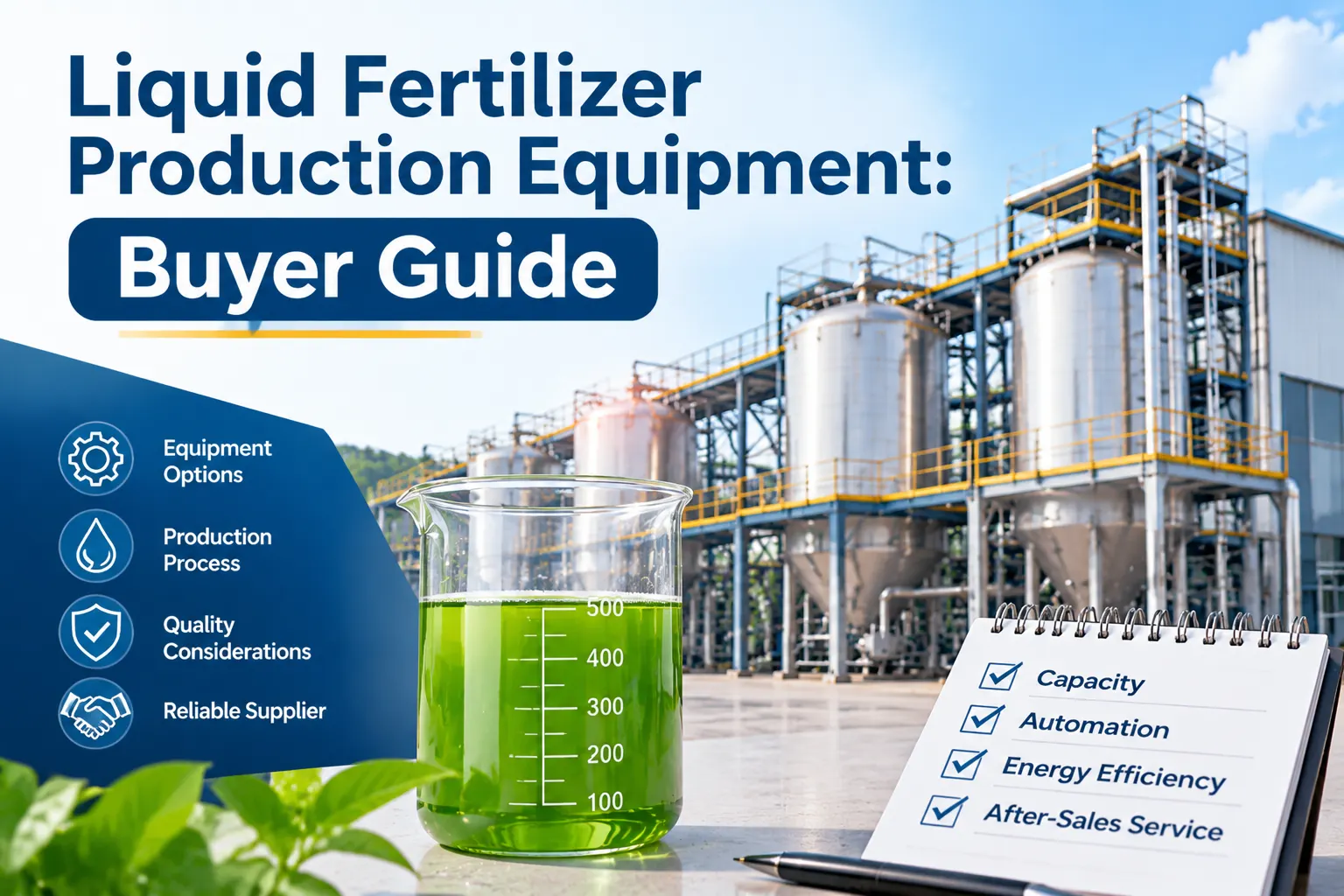
Liquid Fertilizer Production Equipment: Buyer Guide
Liquid fertilizer production equipment must be selected as a coordinated process system. A mixing tank may have enough volume on paper, but that does not mean it can dissolve the required raw materials within the target batch time. A transfer pump may meet the rated flow, yet struggle with a viscous suspension. A filling machine may run at its advertised speed but remain underfed because the buffer tank and upstream process cannot keep up.
For fertilizer plant owners, production managers, and procurement teams, the main purchasing task is to match equipment capacity, wetted materials, mixing performance, filtration, and packaging requirements. This guide explains how to evaluate a complete liquid fertilizer production equipment configuration, identify specification gaps, and avoid paying for equipment that does not fit the actual formulation.
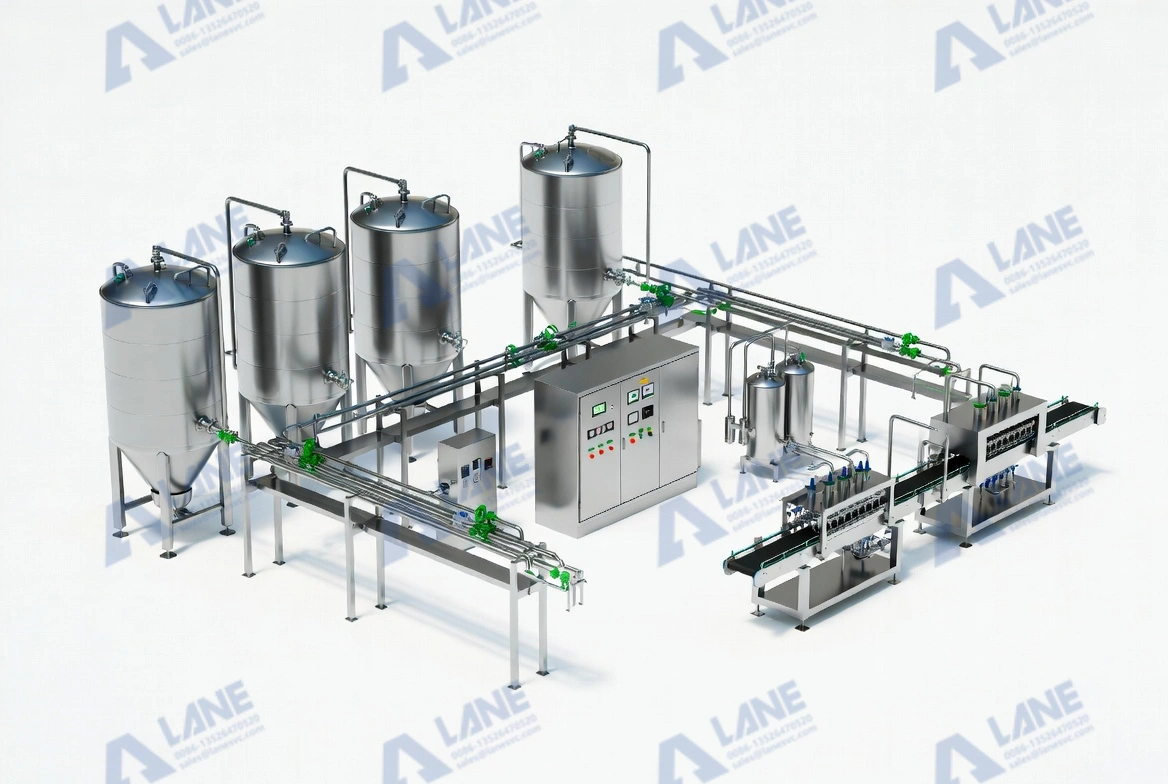
A liquid fertilizer plant is not just a mixing tank connected to a filling machine. It needs a process arrangement that controls raw material feeding, dissolution, mixing, reaction where required, filtration, intermediate storage, and final packaging.
LANE’s published liquid fertilizer production line lists the main equipment as mixing machines, reactor tanks, filters, industrial pumps, gear pumps, pipelines, product storage tanks, and automatic capping and filling machines.
A typical equipment arrangement may include:
The equipment list changes with the product. A clear water-soluble NPK solution may need dissolution, mixing, filtration, and filling. A liquid organic fertilizer may require fermentation and solid-liquid separation. A suspension fertilizer needs suitable dispersion, agitation, and transfer arrangements to prevent excessive settling.
Buyer’s judgment: Do not accept a standard equipment list before the supplier has reviewed your formulation. The correct process route must come before the machine quotation.
Planning a fertilizer project? Contact LANE engineering team to get a free 3D plant layout drawing, motor power calculation, and factory-direct quote within 4 hours. Request 3D Layout & Budget Estimate →
The most important specification is not always the largest capacity number on a product page. Buyers should distinguish between total tank volume, working volume, batch output, and finished product throughput.
For example, a tank with a nominal volume of 10,000 L cannot automatically be treated as a 10,000 L working batch vessel. Freeboard, liquid expansion, foam, mixing requirements, and discharge arrangements affect the usable volume.
The following table summarizes the main equipment groups and the specifications that deserve attention during quotation review.
| Equipment | Main duty | Key specifications to request | What buyers should verify |
|---|---|---|---|
| Dissolving tank | Dissolves soluble raw materials | Working volume, agitator type, motor power, heating method | Dissolution time and complete mixing |
| Mixing tank | Blends liquid ingredients and maintains uniformity | Volume, impeller design, speed control, material grade | Viscosity and solids compatibility |
| Reactor tank | Controls a reaction or process temperature | Design conditions, heating/cooling duty, temperature control | Process requirements and safety provisions |
| Dosing system | Adds ingredients in controlled quantities | Pump type, flow range, pressure, control method | Dosing repeatability under actual conditions |
| Filter | Removes unwanted particles | Filtration rating, flow capacity, cleaning method | Required product cleanliness and pressure loss |
| Transfer pump | Moves product between process stages | Flow rate, head, seal material, wetted material | Actual operating point and fluid properties |
| Storage tank | Holds raw, intermediate, or finished product | Working volume, material, level control, venting | Corrosion compatibility and drainage |
| Filling machine | Fills containers with finished fertilizer | Filling range, filling method, line speed | Package size and actual product behavior |
LANE’s product pages publish the following reference ranges:
| Equipment | Published reference | Selection considerations |
|---|---|---|
| Liquid fertilizer mixing tank | 500–50,000 L; SS304/SS316L options | Batch volume, agitator design, heating or cooling |
| Liquid fertilizer storage tank | 1,000–100,000 L; optional agitation and insulation | Working volume, storage time, temperature and settling |
| Dissolving tank | 500–30,000 L; high-speed agitation and heating options | Solubility, dissolution time, and raw material feed |
| Liquid fertilizer fermentation tank | 500–50,000 L; temperature control and stirring options | Feedstock, fermentation mode, aeration, and process time |
These are published product-page ranges, not a guarantee that every size or option is suitable for every formulation. The final equipment schedule should state the selected volume, material, motor power, agitator configuration, and accessories for each machine.
The tank is only the vessel. Its internal configuration determines whether the product can be processed consistently.
LANE’s liquid fertilizer mixing tank is listed with SS304 or SS316L construction, variable-speed agitation, heating and cooling options, and PLC control. The page describes different agitator arrangements for different duties:
The impeller should be selected according to tank geometry, viscosity, solids loading, and the required mixing time. A higher motor rating does not automatically mean better mixing. Ask for the impeller type, diameter, rotational speed, motor power, and the product conditions used for selection.

For water-soluble raw materials, a dedicated dissolving tank may be more appropriate than using one general-purpose vessel for every operation. It is designed around the dissolution stage, where agitation, heating, and raw material addition determine how quickly a stable solution can be prepared.
SS304 is used in many general liquid fertilizer applications. SS316L may be more suitable for formulations containing aggressive chloride-bearing ingredients, acids, or certain micronutrient combinations. The correct choice depends on concentration, temperature, exposure time, and cleaning chemicals.
Do not confirm the material by checking only the tank shell. The product-contact assembly also includes the agitator shaft, impeller, pump casing, valves, pipe fittings, filter housing, mechanical seals, and gaskets.
Ask the supplier to specify the wetted material grade and provide material certificates where required. If the formulation is corrosive, obtain a written material compatibility review before fabrication.
Pump selection should be based on viscosity, solids content, required flow, discharge pressure, and the chemical properties of the liquid.
Centrifugal pumps are commonly considered for low-viscosity transfer duties. Positive displacement pumps may be more appropriate for viscous products or applications requiring controlled flow. Metering pumps are used where small quantities of additives, acids, or micronutrients must be introduced at a controlled rate.
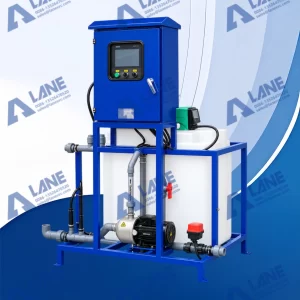
LANE’s liquid dosing system is described as a packaged unit that can include storage or day tanks, metering pumps, flow meters, control valves, injection points, and PLC control.
Procurement check: Request the pump model, operating flow, discharge pressure, motor power, seal material, and the fluid properties used for selection. A maximum flow figure without operating pressure is not enough to compare two pump quotations.
Different liquid fertilizers place different demands on the process equipment. The production route should be chosen before tank volumes and motor power are finalized.
These products generally require accurate batching, dissolution, mixing, and filtration. The key performance checks are dissolution time, batch repeatability, and the absence of unwanted undissolved solids.
A dedicated dissolving tank followed by a mixing or holding vessel may be appropriate where raw materials need separate preparation. The filter should be selected according to the required product cleanliness and the particle characteristics of the feed.
Suspension products contain solid particles dispersed in a liquid phase. They require suitable agitation and, depending on the formulation, high-shear mixing or recirculation.
A conventional low-viscosity transfer pump may not be suitable for every suspension. The buyer should confirm particle size, solids loading, viscosity, and the possibility of settling during storage. Filter selection must also be reviewed carefully: a filter that removes useful suspended particles can change the product composition.
Organic liquid fertilizer production may involve feedstock preparation, fermentation, solid-liquid separation, filtration, storage, and filling.
LANE’s liquid fertilizer fermentation tank is listed with SS304/SS316L options, temperature control, stirring, and defoaming arrangements. The page gives a published capacity range of 500–50,000 L.
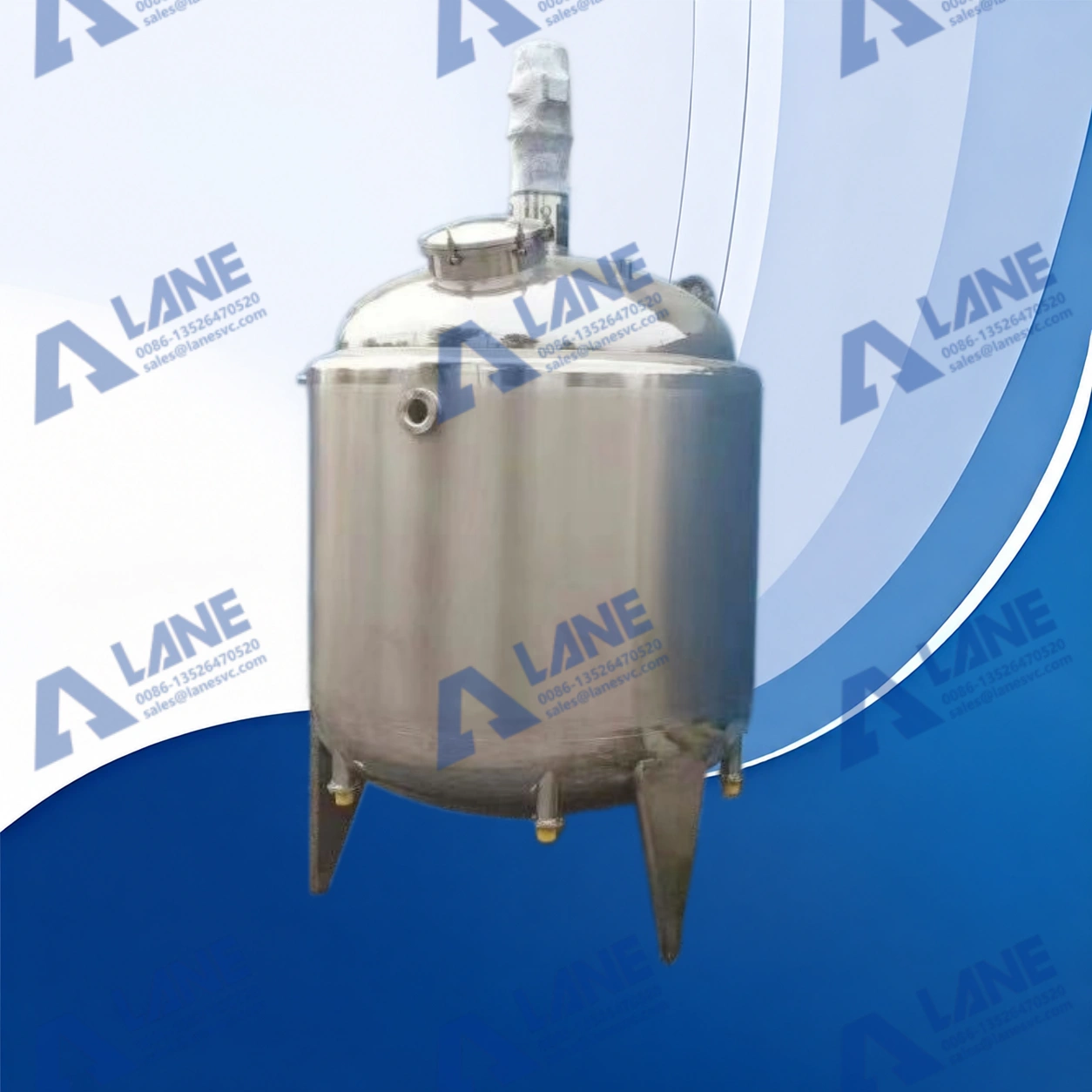
Fermentation is not required for every liquid fertilizer. Clear soluble NPK made by blending nutrient salts does not need a fermentation vessel. Adding one to that type of plant increases equipment and utility costs without serving the process.
For organic feedstocks such as manure liquid, biogas slurry, or seaweed-based materials, the equipment design should account for solids content, aeration or sealing requirements, temperature control, and downstream separation.
A production line can meet its mixing target and still miss the daily dispatch target. This usually happens when the buffer volume, filtration capacity, or packaging section is undersized.
LANE lists liquid fertilizer storage tanks from 1,000 L to 100,000 L, with options such as level monitoring, insulation, recirculation, and agitation.
A storage tank holds raw materials, intermediate product, or finished fertilizer. A buffer tank has a different job: it absorbs the difference between upstream batch production and downstream filling speed.
The required volume depends on the batch cycle, filling rate, storage time, and production schedule. For suspension products, agitation or recirculation may be necessary to maintain product uniformity during holding.
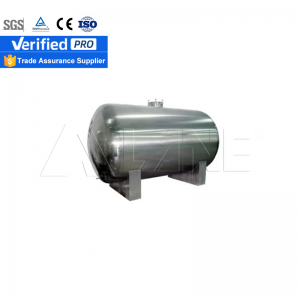
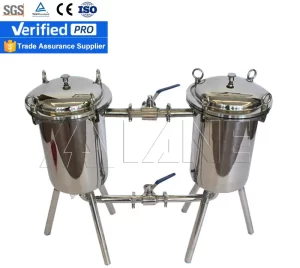
The filter should be selected according to the actual solids and particle-size profile. A duplex filter may allow one filter chamber to remain in operation while the other is cleaned, reducing interruption in continuous service.
LANE lists a stainless steel duplex filter among its liquid fertilizer equipment. Buyers should confirm the filtration rating, effective filtration area, design flow, pressure drop, cleaning method, and compatibility with the product.
Do not specify a fine filtration rating simply because it sounds more thorough. Excessively fine filtration can increase pressure loss, shorten cleaning intervals, or remove particles that are part of the intended suspension product.
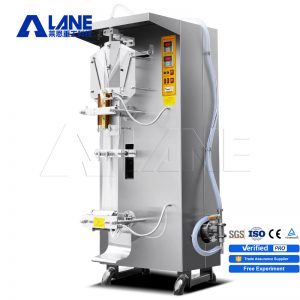
The filling section must match the container type, product viscosity, and required packaging output. LANE’s liquid fertilizer filling machine describes filling methods including gravity or flowmeter filling for clear liquids, pump-based filling for suspensions, piston filling for viscous products, and weighing filling for selected package formats.
Confirm the container sizes, filling range, number of filling heads, accuracy requirement, and downstream capping or conveying arrangement. The filling machine’s rated speed should be checked against the upstream supply rate, not treated as the output of the entire factory.
A useful quotation should allow the buyer to understand exactly what is being purchased. A list of machine names and prices is not enough for a production project.
Request the following documents and details:
LANE’s liquid fertilizer factory design discusses equipment arrangement, storage, capacity planning, and process layout. These points should be reflected in the project drawings and quotation.
For general company information, LANE’s company profile describes its fertilizer machinery range, engineering and installation experience, and overseas service support. Buyers should still verify the exact project scope, certificates, warranty terms, and service commitments applicable to their order.
For quality management terminology and the role of a quality management system, refer to the official ISO 9001 information. A quality-system certificate is useful background, but it does not replace equipment-specific inspection and acceptance criteria.
Yes, some equipment can be shared, but the agitator, pump, filter, and cleaning arrangement may need to change. Clear solutions and suspensions have different viscosity and solids-handling requirements. Ask the supplier to confirm which machines are common to both products and which need dedicated configurations.
Specify the required output per batch and per operating hour, rather than relying on a tank’s nominal volume. The supplier needs to calculate batch time, mixing time, transfer time, filtration capacity, storage volume, and filling speed. A complete line’s output is limited by its slowest process section.
Not for every formulation; the material must be checked against the actual chemical composition and operating conditions. SS304 is suitable for many general applications, while SS316L may be considered for more aggressive chloride-bearing or acidic products. Seals, valves, pumps, and pipe fittings also need compatibility checks.
The schedule depends on the confirmed equipment scope, fabrication requirements, inspection plan, and destination. Ask the supplier to separate drawing approval, manufacturing, factory testing, export packing, shipping, installation, and commissioning milestones. Do not treat a general delivery estimate as a contractual project schedule.
Operators should carry out routine checks during every operating shift, with detailed maintenance scheduled according to equipment duty and manufacturer instructions. Inspect pump leakage, mechanical seals, filter pressure drop, agitator noise, tank outlets, valves, and instrument readings. Keep critical seals, gaskets, filter elements, and pump wear parts available according to the spare parts list.
Before approving a liquid fertilizer production equipment quotation, confirm three technical points:
A low equipment price can become an expensive purchase if the filter blocks repeatedly, the pump cannot handle the product, or the storage section cannot support the filling schedule. Compare quotations by their complete technical scope and operating suitability, not by the number of machines or the headline capacity alone.
LANE supplies liquid fertilizer production equipment for mixing, dissolving, reaction, filtration, transfer, storage, and packaging applications. Provide your formulation, raw material information, target capacity, package type, and factory conditions to request a configuration matched to the project.
For more details, please feel free to contact us.
Henan Lane Heavy Industry Machinery Technology Co., Ltd.
Leave a Comment
Latest Posts
LANE has more than 500 successful cases and is committed to providing customers with first-class solutions, high-end machinery and equipment, and one-stop pre-sales, sales and after-sales comprehensive customer service.