

Set up a Liquid Fertilizer Factory in Europe: A Step-by-Step Guide to Plant Design and Construction
Liquid fertilizer market in Europe is seeing growth due to its compatibility with precision farming and modern farming technologies. The liquid fertilizer market was valued at USD 3.48 billion in 2025 and is projected to reach USD 4.55 billion by 2030. This expansion is driven by the adoption of precision agriculture, stricter environmental regulations, and the EU’s Farm to Fork Strategy which targets a 50% reduction in nutrient losses by 2030. But to set up a liquid fertilizer factory in Europe you will need robust machinery which can produce premium liquid fertilizer while maintaining European regulations.
Successfully navigating the process to set up a liquid fertilizer factory in Europe requires careful planning. This guide walks you through full plant planning, design, construction, equipment configuration, and EU regulatory adaptation with the exclusive turnkey liquid fertilizer production lines provided by LANE Heavy Industry Machinery.
Before you decide to start the production, it is essential to understand the market landscape that will shape your decision to set up a liquid fertilizer factory in Europe. Europe has a total of 157 million hectares of farmland, with countries such as Germany, France, the United Kingdom, and Ukraine leading in liquid fertilizer adoption.
Several key trends make the European market particularly attractive:
Precision Agriculture Integration: Liquid fertilizers integrate seamlessly with technology such as drip irrigation, and fertigation systems. This compatibility is a major driver for farmers who want to optimize input costs.
Regulatory Push for Sustainability: The EU’s Green Deal and Farm to Fork initiatives are incentivizing environmentally friendly fertilizers with reduced carbon footprints. Liquid fertilizers enable precise application, reduce nutrient runoff. Nutrient runoff is a critical concern as agriculture contributes 53% of nitrogen loads in EU freshwater bodies.
Supply Chain Shifts: Geopolitical tensions are creating urgent demand for locally produced alternatives. A European-based factory can capture market share from import-dependent supply chains.
Understanding these dynamics ensures that when you set up a liquid fertilizer factory in Europe, you position your operation for long-term growth and regulatory alignment.
To set up a liquid fertilizer factory in Europe, you need to select a reliable equipment partner. A reliable partner will reduce your workload by half. LANE Heavy Industry has established itself as a premier manufacturer of fertilizer production systems. We offer advanced liquid fertilizer production lines that combine efficiency, precision, and durability.
The LANE Liquid Fertilizer Production Line
LANE Heavy Industry offers turnkey Liquid Fertilizer Production Line with customization options. Our liquid fertilizer production line is engineered for producing high-quality foliar fertilizers.
Sample specifications for a 5 m³/hour production line include:
| Parameter | Specification |
| Production Capacity | 5 m³/hour |
| Material | Customizable (304/316 stainless steel options) |
| Certification | GS, CE, ISO 9001 |
| After-Sales Service | Remote Video Guidance |
| Transport Package | Standard Wooden Package |
This production line is designed to handle a comprehensive raw material range, including water (as solvent and carrier), nitrogen, phosphorus, potassium (as primary nutrients), emulsifiers for even distribution, and stabilizers/pH regulators for product integrity.
Core Equipment Components
A complete LANE production line for liquid fertilizer manufacturing includes the following essential modules:
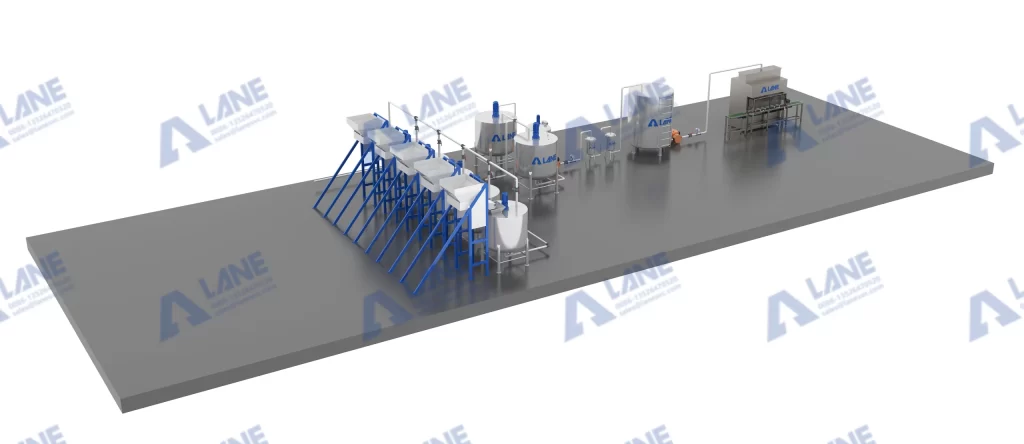
Production Process Overview
The LANE production line follows an optimized six-step process:
LANE Heavy Industry provides CE-certified machinery that already meets European safety and quality standards to set up a liquid fertilizer factory in Europe.
Designing an efficient facility is the first critical step when you set up a liquid fertilizer factory in Europe. The layout must balance production flow with safety and environmental compliance.
Space Requirements
For a production capacity of approximately 5 m³/hour (equivalent to roughly 5-8 tons per hour), a facility of 1,000 to 2,000 square meters is required. This space allocation includes:
Layout Principles
Effective plant design should follow these proven principles:
Understanding the capital requirements to set up a liquid fertilizer factory in Europe is essential for securing financing and developing a realistic business plan.
Equipment Investment
For a LANE Heavy Industry production line with 5 m³/hour capacity:
| Cost Component | Estimated Range (USD) |
| Core Production Equipment | $60,000 – $90,000 |
| Automation & Control Systems | $20,000 – $35,000 |
| Auxiliary Equipment (filtration, pumps, piping) | $15,000 – $25,000 |
| Packaging Line | $15,000 – $60,000 |
| Total Equipment Investment | $110,000 – $210,000 |
This aligns with industry benchmarks: a 5-10 T/H liquid fertilizer production line typically costs between $60,000 and $150,000 depending on automation level and material specifications.
Operating Cost Considerations
Beyond capital investment, plan for ongoing expenses:
Perhaps the most complex aspect of any plan to set up a liquid fertilizer factory in Europe is ensuring full compliance with the European Union’s sophisticated regulatory framework.
The Fertilising Products Regulation (FPR) — EU 2019/1009
The FPR, effective since July 2022, established rules for placing fertilizer products on the EU market. To legally set up a liquid fertilizer factory in Europe and sell products with CE marking, your operations must meet the following requirements:
REACH Registration Requirements
A critical and often overlooked requirement when you set up a liquid fertilizer factory in Europe is compliance with the REACH Regulation (EC 1907/2006). Key points include:
Modern investors who want to set up a liquid fertilizer factory in Europe should consider integrating circular economy principles into their operations. The EU is actively promoting nutrient recovery from waste streams as a key strategy to reduce dependence on imported mineral fertilizers.
LANE has engineered innovative technologies that recover nitrogen and phosphorus from wastewater, liquid digestate, and manure. By incorporating such sustainable raw materials into your production line, you can:
LANE Heavy Industry’s production lines can be customized to handle both conventional and recovered nutrient streams, offering flexibility as sustainability regulations evolve.
The final phase to set up a liquid fertilizer factory in Europe involves executing your plan with precision. A typical implementation timeline follows this sequence:
| Phase | Duration | Key Activities |
| 1. Planning & Permitting | 3-6 months | Site selection, regulatory approvals, business registration |
| 2. Equipment Procurement | 2-4 months | Order LANE production line, manage international shipping |
| 3. Facility Construction | 4 months | Building construction/renovation, utility installation |
| 4. Installation & Commissioning | 1-2 months | Equipment installation, system integration, calibration |
| 5. Trial Production | 1 month | 72-hour continuous test run, quality validation |
| 6. Full Commercial Operation | Ongoing | Market launch, distribution network development |
Total estimated timeline: 7-17 months from initial planning to full-scale production when you set up a liquid fertilizer factory in Europe.
How long does it take to set up a liquid fertilizer factory in Europe with LANE equipment?
From site planning, regulatory approval, construction to full production, the total cycle is 5-17 months, depending on plant scale and local permit processing speed.
Does LANE’s liquid fertilizer production line meet EU fertilizer regulations?
Yes. All equipment is CE-certified, fully complying with EU Regulation 2019/1009 and REACH rules, supporting compliant product sales across all European member statesEUR-Lex.
What production capacities are available when you set up a liquid fertilizer factory in Europe?
LANE provides customized lines from 500L/H to 25,000L/H, suitable for small regional plants to large industrial factories serving European large-scale farms.
What raw materials can the LANE line process for European liquid fertilizer production?
It adapts to biogas digestate, livestock manure, agricultural organic waste, nutrient salts, trace elements, Chemical and organic raw materials for liquid fertilizer production.
Does LANE provide after-sales service after we set up a liquid fertilizer factory in Europe?
LANE offers global on-site installation, operator training, spare parts supply, lifetime technical consultation, and remote system maintenance for all European projects.
For more details, please feel free to contact us.
Henan Lane Heavy Industry Machinery Technology Co., Ltd.
Email: sales@lanesvc.com
Contact number: +86 13526470520
Whatsapp: +86 13526470520
Leave a Comment
Latest Posts
LANE has more than 500 successful cases and is committed to providing customers with first-class solutions, high-end machinery and equipment, and one-stop pre-sales, sales and after-sales comprehensive customer service.