
Microbial Stabilizers for Commercial Bio Mineral Liquid Fertilizer Production: Key Formulation Strategies for Manufacturers
You are an experienced fertilizer manufacture and now you want to attempt to make a new liquid bio fertilizer, but your live microbes are dying and you don’t know what to do. Every manufacturer who attempted to enter the biological sector has faced this issue. High osmotic pressure and sharp chemical shear forces wipe out beneficial bacteria populations. This leads to separating liquids, failed lab assays, and costly product returns. The solution lies in deploying specialized microbial stabilizers for commercial bio mineral liquid fertilizer production that shield living cells from osmotic stress and cellular damage.
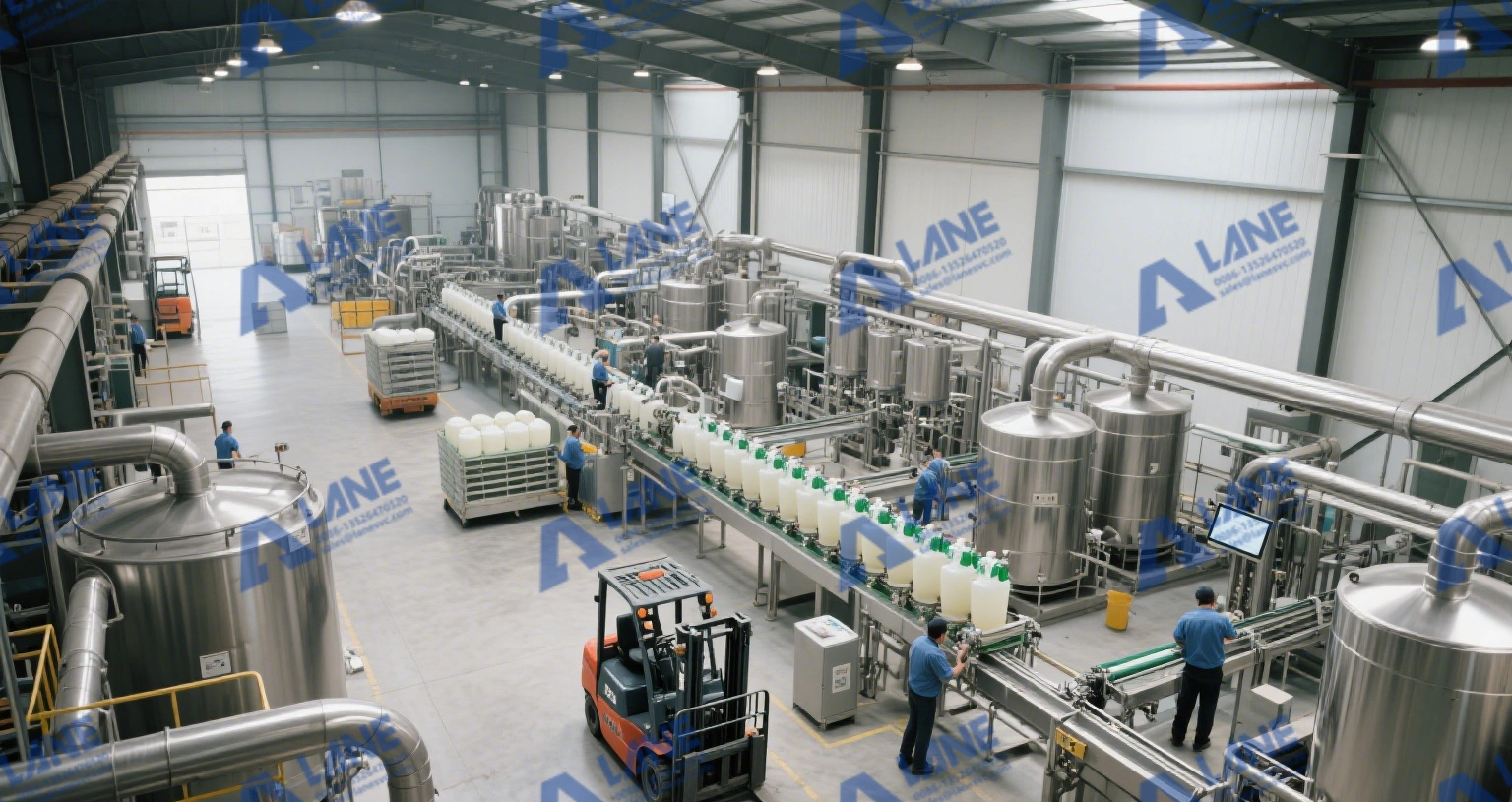
Bio mineral liquid fertilizer has become popular because they combine beneficial microorganisms with essential mineral nutrients. This gives the farmers best of both worlds. However, to successfully create bio mineral fertilizer you will need specialized, low-shear industrial mixing technology along with microbial stabilizers for commercial bio mineral liquid fertilizer production. LANE Heavy Industry, has manufactured liquid fertilizer production line which can create stable and commercially viable liquid biofertilizer products.
Liquid NPK mineral fertilizers are chemically hostile environment for living microorganisms. High concentrations of synthetic or organic salts like potassium phosphate, ammonium sulfate, or zinc chelates create a medium with low water activity and intense osmotic pressure. These osmotic gradient draws water out of microbial cells which leads to rapid plasmolysis, metabolic collapse, and cellular death.
High Osmotic Pressure / Low Water Activity →Moisture Drawn Out of Cell Wall →Plasmolysis & Microbial Cell Death
To overcome this, commercial manufacturers must rely on complex stabilizing matrices. Using robust, high-performance microbial stabilizers for commercial bio mineral liquid fertilizer production will make your production process easier. The chemical matrices preserve cell wall integrity and maintain a state of metabolic dormancy until the fertilizer is diluted with water and applied to the soil.
Developing a resilient bio-mineral liquid requires a multi-tiered stabilization framework. Commercial manufacturers combine several distinct additive groups to protect the biological lifeform against the physical and chemical stress during storage and transportation.
Osmoprotectants and Compatible Solutes
Osmoprotectants are small organic molecules that microbes accumulate to balance external osmotic pressure without disrupting internal metabolic machinery.
Polymeric Viscosity Modifiers and Encapsulants
High-molecular-weight polymers play a double role by preventing the sedimentation of suspended minerals and physically shield microbes from physical shear forces during mechanical blending.
Advanced pH Buffering Systems
Microbial viability drops when they are exposed to sharp pH deviations. Organo-mineral formulations must include chemical buffers such as dipotassium phosphate or citric acid-citrate buffers to lock the liquid matrix within an optimal physiological range (typically pH 6.5–7.2) over an extended shelf life.
The successful integration of microbial stabilizers for commercial bio mineral liquid fertilizer production depends heavily on the mechanical processing environment. Standard high-speed industrial agitators generate intense localized hydrodynamic shear forces and localized temperature spikes that can strip away protective polymer coatings and lyse fragile microbial cells.
LANE Heavy Industry has over two decades of experience in manufacturing chemical industrial equipment. We engineer large-scale fertilizer production machinery explicitly engineered to handle high-viscosity, sensitive bio-chemical suspensions.
Step 1: Mineral Solubilization via LANE High-Shear Dissolving Tanks
Before introducing biological components, the mineral base must be completely dissolved and chelated. LANE Heavy Industry’s High-Shear Dissolving Tanks utilize high-torque agitators to completely break down crystalline macro and micronutrients. Complete dissolution prevents the formulation of undissolved abrasive mineral crystals. Abrasive mineral crystals could mechanically damage microbial membranes later in the process.
Step 2: Stabilizer Hydration and Matrix Conditioning
Once the mineral solution is prepared and cooled to ambient room temperature (under 30°C), the chosen microbial stabilizers for commercial bio mineral liquid fertilizer production are introduced. Polymers like xanthan gum require through, lump-free hydration. LANE’s specialized powder-induction blending systems pull these dry stabilizers directly into the liquid stream, ensuring a perfectly homogenous, shear-thinning protective matrix without air entrainment.
Step 3: Low-Shear Microbial Inoculation via LANE Bio-Blending Vessels
This is the last stage of microbial stabilizers for commercial bio mineral liquid fertilizer production. In this stage manufacturer uses Low-Shear Bio-Blending Vessels. These units feature custom-engineered paddle or anchor agitators. They have RPM of <60.
This low-shear design ensures that living microorganisms are gently folded into the pre- hydrated stabilizing matrix. Additionally, LANE vessels are equipped with precise jacketed cooling controls to counteract any exothermic reactions that could cause thermal stress to the biological materials.
Incorporating microbial stabilizers for commercial bio mineral liquid fertilizer production at this exact stage protect them from earlier high shear chemical dissolutions and optimizes the viability metrics.
Step 4: Automated Fluid Packaging
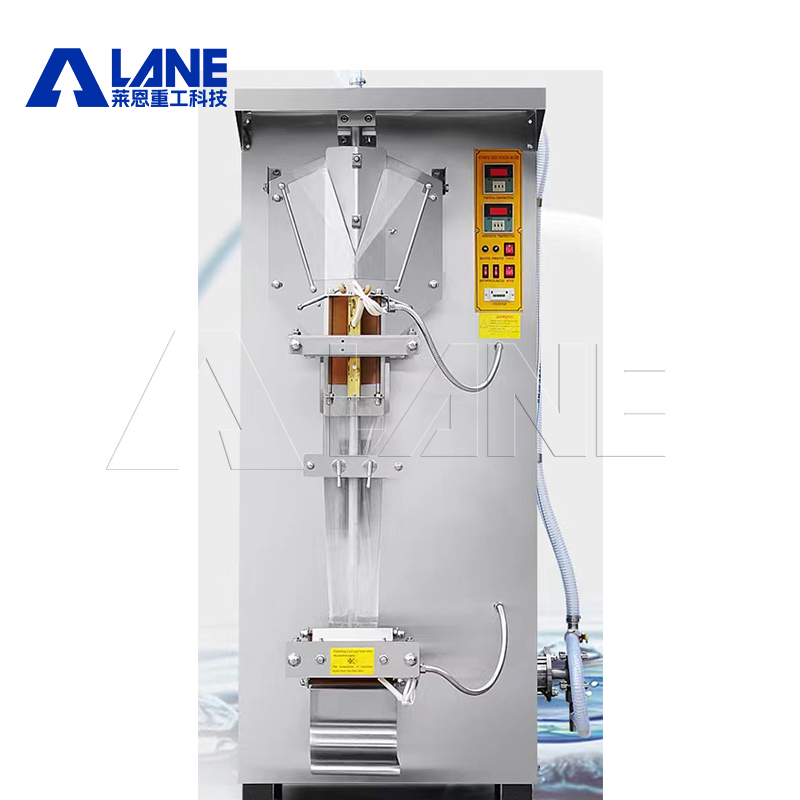
Following homogenization, the stabilized liquid is transferred directly to LANE Automated Packaging Lines. These filling machines utilize positive- displacement diaphragm or peristaltic pumps that prevent crushing forces on micro-encapsulated colonies. This ensures the structural integrity of the formulation from the tank to the final commercial container.
Technical Summary of Bio-Mineral Formulation Parameters
| Formulation Component | Target Function | Recommended Processing Equipment |
| Chelated Minerals (NPK + Trace) | Primary Crop Nutrition | LANE High-Shear Dissolving Tank |
| Osmoprotectants (Trehalose/Betaine) | Intracellular Osmotic Balancing | LANE Auxiliary Chemical Induction System |
| Viscosity Hydrocolloids (Xanthan/CMC) | Suspension & Mineral Isolation | LANE Powder-Liquid Blending Loop |
| Living Inoculants (PGPR/Bacillus spp.) | Biological Activity | LANE Low-Shear Bio-Blending Vessel |
They are additives and formulation aids that protect live microbes and help maintain physical stability in liquid bio mineral fertilizers.
They improve shelf life, reduce separation, protect microbial viability, and help maintain batch consistency.
No. Different strains respond differently to pH, salts, heat, and osmotic stress, so the stabilizer package must be tested for each formulation.
They are usually added near the end of processing, after the mineral phase has cooled and stabilized.
Low-shear mixers, accurate dosing systems, corrosion-resistant tanks, controlled transfer pumps, and reliable filling machinery are especially useful.
For more details, please feel free to contact us.
Henan Lane Heavy Industry Machinery Technology Co., Ltd.
Email: sales@lanesvc.com
Contact number: +86 13526470520
Whatsapp: +86 13526470520
Leave a Comment
Latest Posts
LANE has more than 500 successful cases and is committed to providing customers with first-class solutions, high-end machinery and equipment, and one-stop pre-sales, sales and after-sales comprehensive customer service.