
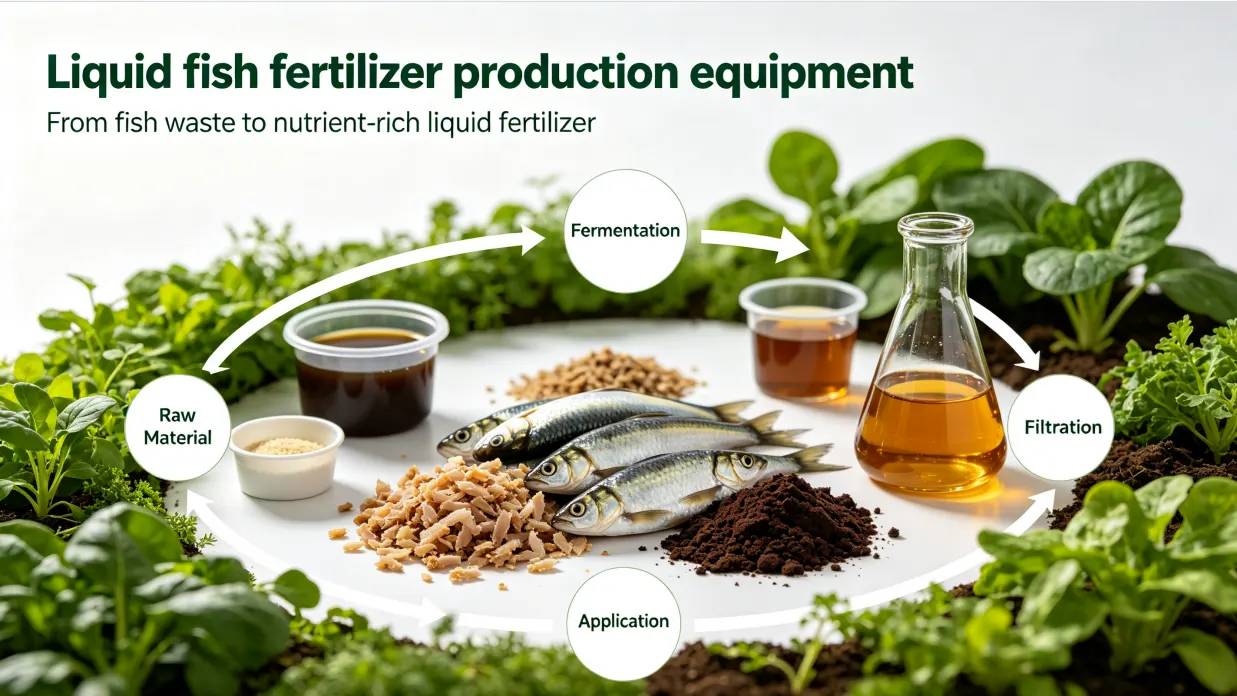
Fish processing plants, seafood factories, and fish markets generate large quantities of heads, frames, skins, viscera, and other protein-rich by-products. Instead of treating these materials as disposal problems, fertilizer manufacturers can process them into liquid fish fertilizer for agricultural use.
However, choosing liquid fish fertilizer production equipment is not simply a matter of buying a grinder and a mixing tank. The raw material condition, hydrolysis method, separation requirements, odor control, and final product specifications all influence the equipment configuration.
For factory owners and purchasing managers, the real question is not which machine has the largest motor. It is whether the complete system can handle the actual fish waste supply, produce a consistent liquid product, and operate at a reasonable cost. This guide explains the main processing options, essential equipment, selection parameters, and supplier checks before investment.
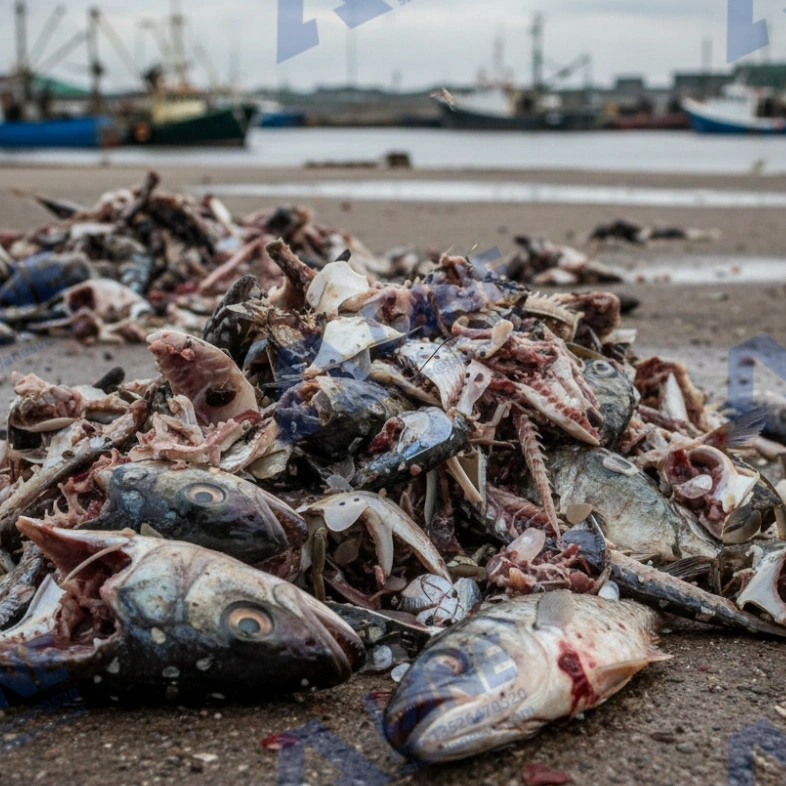
Liquid fish fertilizer is generally produced by processing fish materials into a liquid containing soluble nutrients, amino acids, peptides, and other organic compounds. The exact composition depends on the fish species, freshness, processing method, and any additional ingredients.
The term is sometimes used broadly to describe different products, including fish hydrolysate, fish emulsion, and fermented fish-based fertilizer. These products are not necessarily manufactured in the same way.
This distinction matters when purchasing liquid fish fertilizer production equipment. A system designed for simple acidified fish silage may not provide the same temperature control, enzyme dosing, or fermentation functions required by an enzymatic or microbial process.
The first purchasing decision should therefore be the product specification and process route—not the machine model.
There are several ways to convert fish-processing by-products into liquid fertilizer. The most appropriate route depends on raw material freshness, available utilities, target product quality, and operating budget.
Enzymatic hydrolysis uses proteolytic enzymes to break down fish proteins into smaller peptides and amino acids. Fish materials are usually ground first to improve contact between the raw material and the enzymes.
The mixture is then processed under controlled conditions. Temperature, pH, enzyme dosage, mixing intensity, and reaction time all affect hydrolysis performance.
This route is worth evaluating when the product strategy emphasizes soluble protein components and amino-acid-containing liquid fertilizer. However, enzymes add operating costs, and the process needs reliable temperature and pH control.
In an acid-based process, ground fish waste is mixed with an acid to reduce pH and support liquefaction and preservation. The resulting material may require screening or other separation steps to remove bones and coarse solids.
This route can be attractive when the factory needs a relatively straightforward process and has access to suitable acid-handling facilities. The buyer must still evaluate corrosion resistance, operator safety, acid consumption, and the final product’s pH.
A standard carbon-steel mixing tank should not automatically be assumed suitable for acidic fish slurry. Material compatibility needs to be confirmed against the actual acid type, concentration, temperature, and cleaning chemicals.
Microbial processing uses selected microorganisms to degrade fish waste and convert part of its organic matter into a liquid fertilizer product. Compared with a simple mixing operation, this route places greater demands on fermentation management.
A published study on fish-waste bioconversion used a 5 L ribbon-type reactor and reported a 96-hour biodegradation process under its experimental conditions. The result demonstrates the potential of biological conversion, but it should not be treated as a universal commercial production cycle.
For buyers, the practical lesson is clear: fermentation equipment must be selected around the chosen microbial process. Aeration, agitation, temperature monitoring, and cleaning arrangements may all affect stable operation.
A commercial system usually combines several processing units. The exact configuration should be determined by the raw material and production route.
| Equipment | Main Function | Purchasing Consideration |
|---|---|---|
| Fish Waste Grinder | Reduces heads, frames, skins, and other fish residues into smaller particles. | Check feeding structure, cutting performance, material compatibility, and cleaning access. |
| Raw Material Mixing Tank | Blends ground fish waste with water, enzymes, acids, or other ingredients. | Confirm effective working volume, agitator type, and corrosion resistance. |
| Hydrolysis or Reaction Tank | Provides a controlled environment for enzymatic or acid-based processing. | Check heating or cooling requirements, temperature monitoring, sealing, and discharge design. |
| Fermentation Tank | Supports microbial conversion when a fermentation route is selected. | Confirm aeration, agitation, temperature control, and sampling arrangements. |
| Solid-Liquid Separator | Removes bones, coarse solids, and other insoluble materials. | Select according to particle size, slurry viscosity, and required liquid recovery. |
| Fine Filtration Unit | Reduces remaining suspended particles. | Match filtration accuracy to the final product and filling equipment. |
| Transfer Pumps and Pipelines | Move fish slurry and finished liquid between process stages. | Check solids-handling capability, seal materials, and corrosion resistance. |
| Finished-Product Storage Tank | Holds processed fertilizer before packaging. | Consider tank material, cleaning access, mixing needs, and storage volume. |
| Filling and Capping Machine | Fills the final product into containers and seals them. | Match filling range, container type, and packaging speed. |
The equipment list is a process framework, not a fixed package for every factory. For example, a simple acidified fish silage project may not need the same fermentation configuration as a microbial production line.
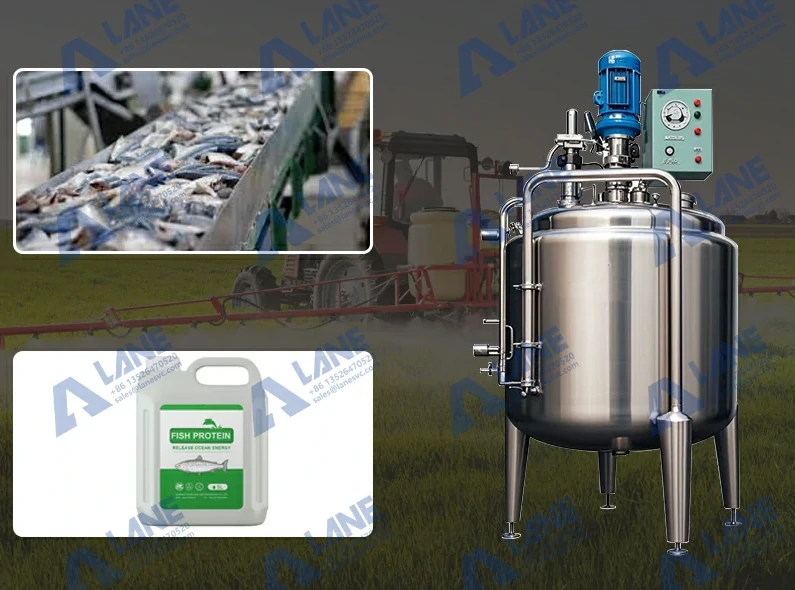
LANE’s liquid fertilizer production line page identifies grinding, mixing, reactor tanks, filters, industrial pumps, pipelines, storage tanks, and automatic filling and capping machines as major equipment categories. These provide a useful starting point for discussing a customized fish-based fertilizer line.
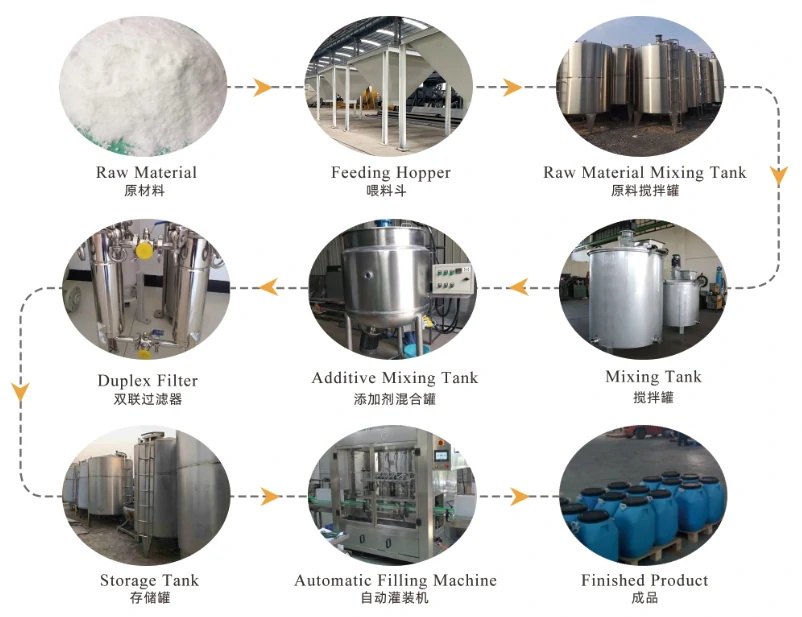
Related solution: Liquid fertilizer production line.
LANE lists a stainless steel mixing tank with a stated barrel-volume range of 100–10,000 L, spindle-speed range of 0–150 rpm, and SUS304 or SUS316 material options. These are published product-page specifications, not a guarantee that every configuration is suitable for fish slurry.
For a fish fertilizer project, the buyer should confirm the actual working volume, agitator design, motor power, heating or cooling arrangement, and material compatibility. The listed 75 kW power figure should also be checked against the selected tank size and configuration before it is used in a project design.
The following table summarizes practical questions to raise during equipment evaluation.
| Parameter | What Buyers Should Request | Why It Matters |
|---|---|---|
| Working Volume | Effective batch volume, not only nominal tank volume. | Prevents underestimating the required number of batches. |
| Agitator | Blade type, speed range, motor power, and mixing test. | Fish slurry may contain fibers, bones, and viscous material. |
| Contact Material | SUS304, SUS316, or another specified material with grade confirmation. | Acidic and saline materials can create corrosion risks. |
| Temperature Control | Heating or cooling method and control accuracy. | Important for enzyme activity and fermentation stability. |
| pH Monitoring | Sensor type, measurement range, and calibration method. | Helps maintain the intended reaction conditions. |
| Separation | Screen size, filter arrangement, and solids discharge method. | Affects liquid recovery and downstream filtration. |
| Cleaning | Drainage design, access openings, and cleaning procedure. | Reduces residue buildup, odor, and contamination. |
| Automation | Manual, semi-automatic, or PLC control. | Influences labor requirements and process repeatability. |
Do not accept a quotation that only lists tank capacity and motor power. For fish-based materials, the supplier should understand the physical behavior of the slurry and explain how each machine handles it.
Capacity planning is one of the most common sources of mistakes in fertilizer plant investment. A grinder rated for a certain amount of raw material per hour does not mean the complete production line can deliver the same amount of finished liquid fertilizer per hour.

Fish fertilizer production involves several stages, and each may have a different processing time. Grinding may be relatively quick, while hydrolysis or fermentation can require a longer holding period. Separation and filtration can also become bottlenecks when the slurry contains high levels of insoluble material.
Before selecting liquid fish fertilizer production equipment, calculate capacity using the following information:
For example, a factory receiving 5 tonnes of fish waste per day should not automatically purchase a 5-tonne reaction tank. The required tank volume depends on the bulk density of the prepared slurry, the liquid-to-solid ratio, working-volume allowance, and the reaction cycle.
A more reliable design starts with a mass-balance calculation. The supplier should estimate raw material input, added water and process ingredients, separated solids, liquid product output, and expected process losses.
The biggest operational problems often originate before the raw material enters the main reaction tank.
Fish waste can deteriorate quickly if it is not handled correctly. Decomposed or inconsistent raw materials may create odor problems and lead to unpredictable processing results.
A practical factory should establish receiving standards for freshness, temperature, contamination, and raw material composition. If the incoming material varies significantly, the production process needs enough flexibility to adjust the recipe and operating conditions.
Large pieces of fish skin, bones, and connective tissue can slow down hydrolysis and increase the load on separation equipment. Grinding should produce a particle size suitable for the selected process rather than simply making the material look smaller.
A liquid product that looks acceptable immediately after processing may still contain particles that settle during storage or block filling nozzles. Buyers should evaluate the separation system using actual fish slurry, not clean water.
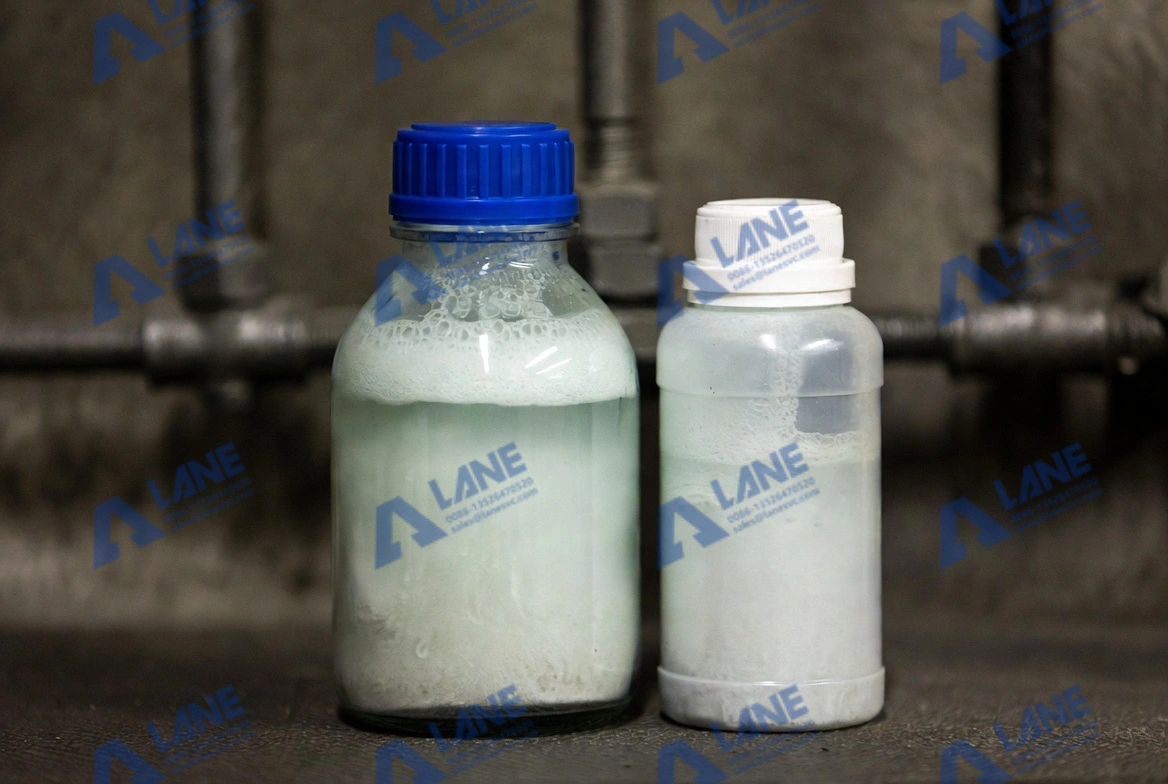
Acidic ingredients, salts, and fish-derived organic matter can create demanding operating conditions. Equipment material, seals, pipelines, and cleaning procedures need to be considered together.
Odor control should also be included in the plant layout. Depending on the process, enclosed receiving, controlled ventilation, exhaust treatment, and suitable wastewater handling may be necessary.
An often-overlooked cost is the cleaning and maintenance burden created by poorly designed transfer lines and tanks. Residue trapped in dead corners or narrow pipelines can cause odor, blockages, and downtime. A slightly more expensive hygienic design may be more economical over the plant’s operating life.
There is no reliable universal price for a fish fertilizer production line. The investment depends on whether the buyer needs a basic processing setup or a more complete automated system.
The main cost components include:
A simple fish silage project may require fewer process units than an enzymatic or microbial system with more demanding controls. However, the cheapest equipment configuration is not necessarily the lowest-cost solution over time.
When comparing quotations, request a clear breakdown of equipment, material grades, motor power, control systems, installation scope, spare parts, and shipping. Also ask whether the price includes commissioning support and operator training.
For a more accurate proposal, provide the supplier with your daily raw material supply, target output, preferred process route, available workshop space, and final packaging requirements.
A supplier should be able to discuss the process, not just send a catalogue of machines.
Before placing an order, ask these questions:
LANE’s liquid fertilizer equipment range includes stainless steel mixing tanks, storage tanks, screw extrusion dehydrators, and other equipment categories. The company also describes services such as equipment selection, engineering design, 3D drawings, manufacturing, delivery, and overseas installation support.
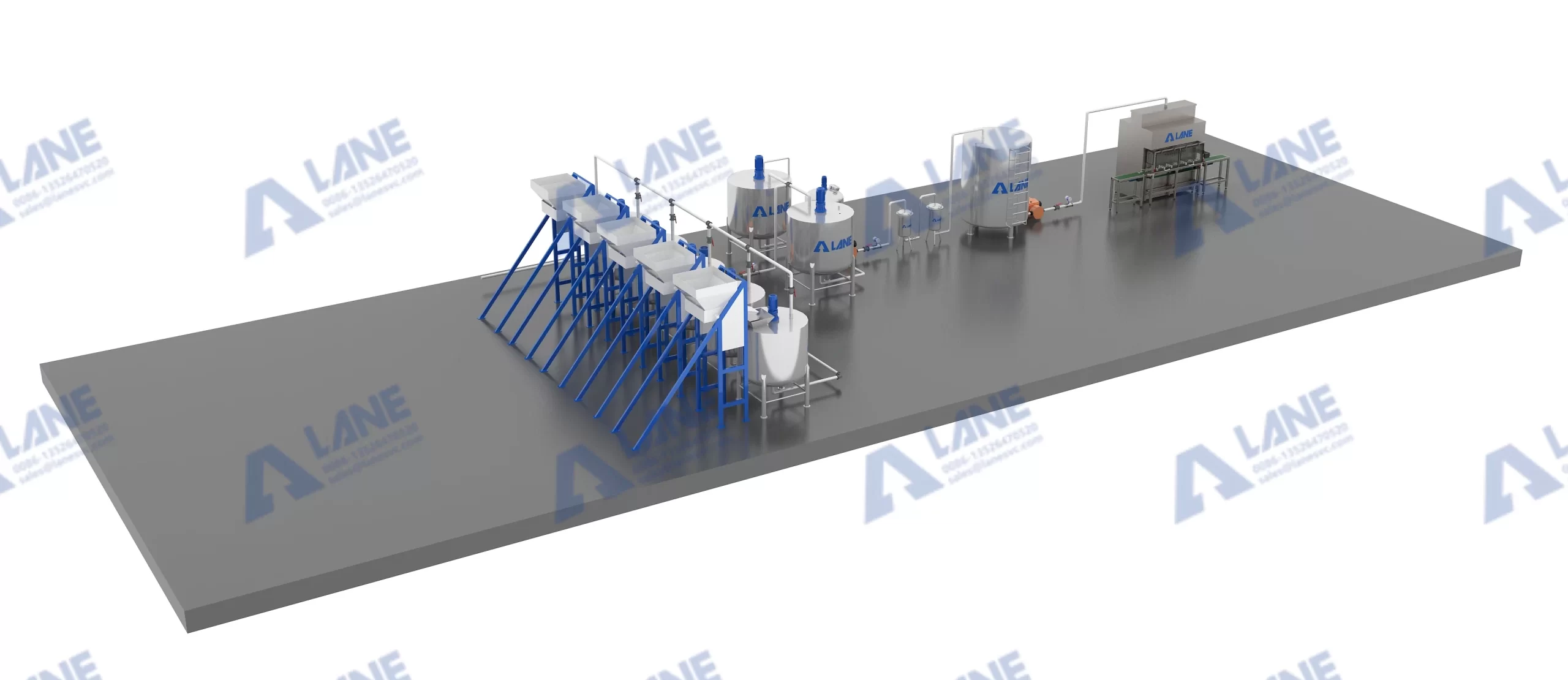
For fish fertilizer projects, these capabilities should be discussed in relation to the actual process. A general liquid fertilizer line should be adapted to the properties of fish waste rather than assumed to be a ready-made fish hydrolysate system.
You can review the stainless steel mixing tank and stainless steel storage tank pages to understand the available equipment categories.
Fish heads, frames, skins, viscera, trimmings, and other suitable fish-processing by-products can be used. However, the raw materials should be assessed for freshness, salt content, contamination, and composition before equipment selection.
Yes, a grinder is normally required for processing whole fish waste or large pieces. Reducing particle size improves mixing and contact during hydrolysis, although the required grinding fineness depends on the separator and process design.
Fish hydrolysate is generally associated with protein breakdown through enzymatic or related hydrolysis processes. Fish emulsion is a broader commercial term often used for processed fish-derived liquid products, including products involving heating and separation. Buyers should confirm the actual manufacturing process rather than relying on the product name alone.
It may be possible to design a flexible line, but the two processes have different requirements. The supplier must evaluate tank configuration, temperature control, aeration, cleaning, and process separation before confirming that one system can handle both routes.
There is no single production time for all fish fertilizer processes. The cycle depends on raw material preparation, enzyme activity, acidification, microbial activity, reaction temperature, and the required product characteristics. The process should be validated using the buyer’s actual raw materials.
Yes, but the equipment configuration must account for them. Grinding, screening, oil separation, and filtration may be needed depending on bone size, oil content, and the final product specification.
Start with fresh raw materials and minimize unnecessary storage before processing. Enclosed handling, suitable ventilation, controlled processing, effective cleaning, and appropriate exhaust treatment can help manage odor. The exact arrangement depends on the production route and local environmental requirements.
A project can be discussed on a customized basis according to raw material type, target capacity, processing route, and packaging requirements. Buyers should provide these details so the supplier can evaluate the required grinder, tanks, separation equipment, pumps, and control system.
For a commercial fish fertilizer project, the most important purchasing decision is the match between raw material characteristics, processing route, and equipment configuration. A grinder with high throughput cannot compensate for an undersized reaction tank, unsuitable contact materials, or an inefficient separation system.
Before ordering liquid fish fertilizer production equipment, buyers should confirm the raw material supply, define the intended product, compare enzymatic, acid-based, and microbial processing routes, and request a process-based equipment proposal. The supplier should also explain how the system will handle odor, corrosion, cleaning, and variable raw material conditions.
LANE provides liquid fertilizer equipment and customized production-line services. If you are planning a fish-based liquid fertilizer project, share your raw material details and target capacity to discuss a suitable equipment configuration.
For more details, please feel free to contact us.
Henan Lane Heavy Industry Machinery Technology Co., Ltd.
Email: sales@lanesvc.com
Contact number: +86 13526470520
WhatsApp: +86 13526470520
Leave a Comment
LANE has more than 500 successful cases and is committed to providing customers with first-class solutions, high-end machinery and equipment, and one-stop pre-sales, sales and after-sales comprehensive customer service.