
Liquid Fertilizer Storage Tank: Buyer’s Selection Guide
A liquid fertilizer storage tank does more than hold finished product before packaging. It provides a controlled buffer between production, filtration, transfer, and filling. If its capacity is too small, the production line may have to stop while the filling section catches up. If the tank is poorly matched to the formulation, sediment can accumulate, cleaning becomes difficult, and product quality may vary between batches.

For fertilizer plant owners, production managers, and equipment purchasing teams, the important question is not simply how many liters a tank can hold. It is whether the tank’s material, internal geometry, connections, and operating arrangement fit the actual liquid fertilizer process.
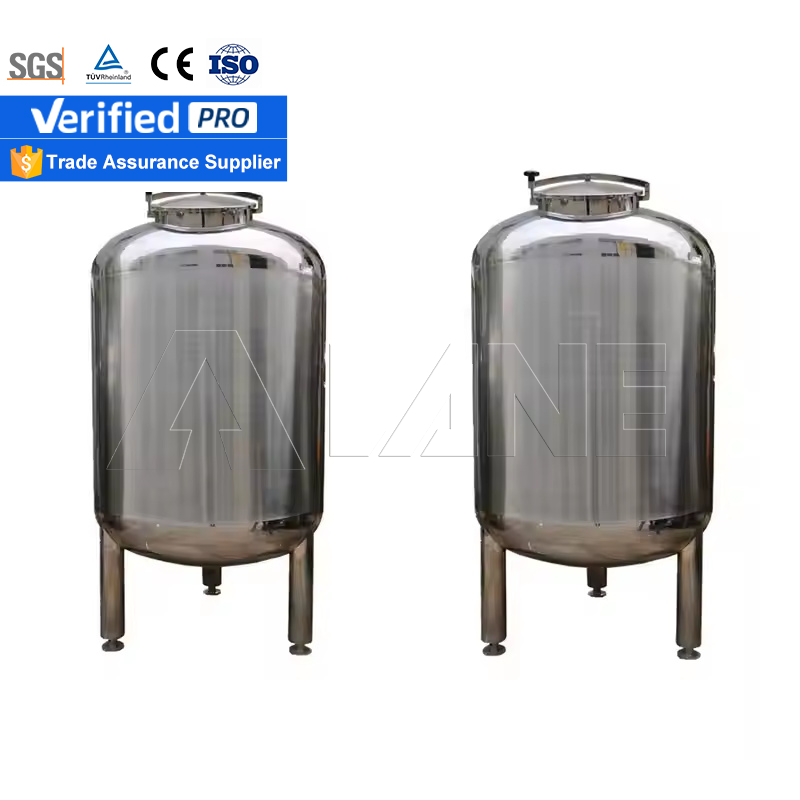
LANE supplies stainless steel storage tanks with listed capacities from 1,000 L to 100,000 L. This guide examines the published specifications and explains what buyers should confirm before selecting a model.
A storage tank normally receives liquid after mixing, reaction, or filtration and holds it until the next processing step. Depending on the plant arrangement, it may serve as a temporary buffer tank, an intermediate process tank, or a finished-product storage vessel.
These duties are not identical.
A liquid fertilizer storage tank should be selected according to its actual duty. A vessel receiving material directly from a reactor may need different connections and cleaning arrangements from a tank holding finished fertilizer for several days.
In a complete production line, the tank is connected to other equipment rather than operating independently. LANE’s liquid fertilizer production line page identifies mixing machines, reactor tanks, filters, industrial pumps, pipelines, product storage tanks, and automatic filling machines as part of the production system.
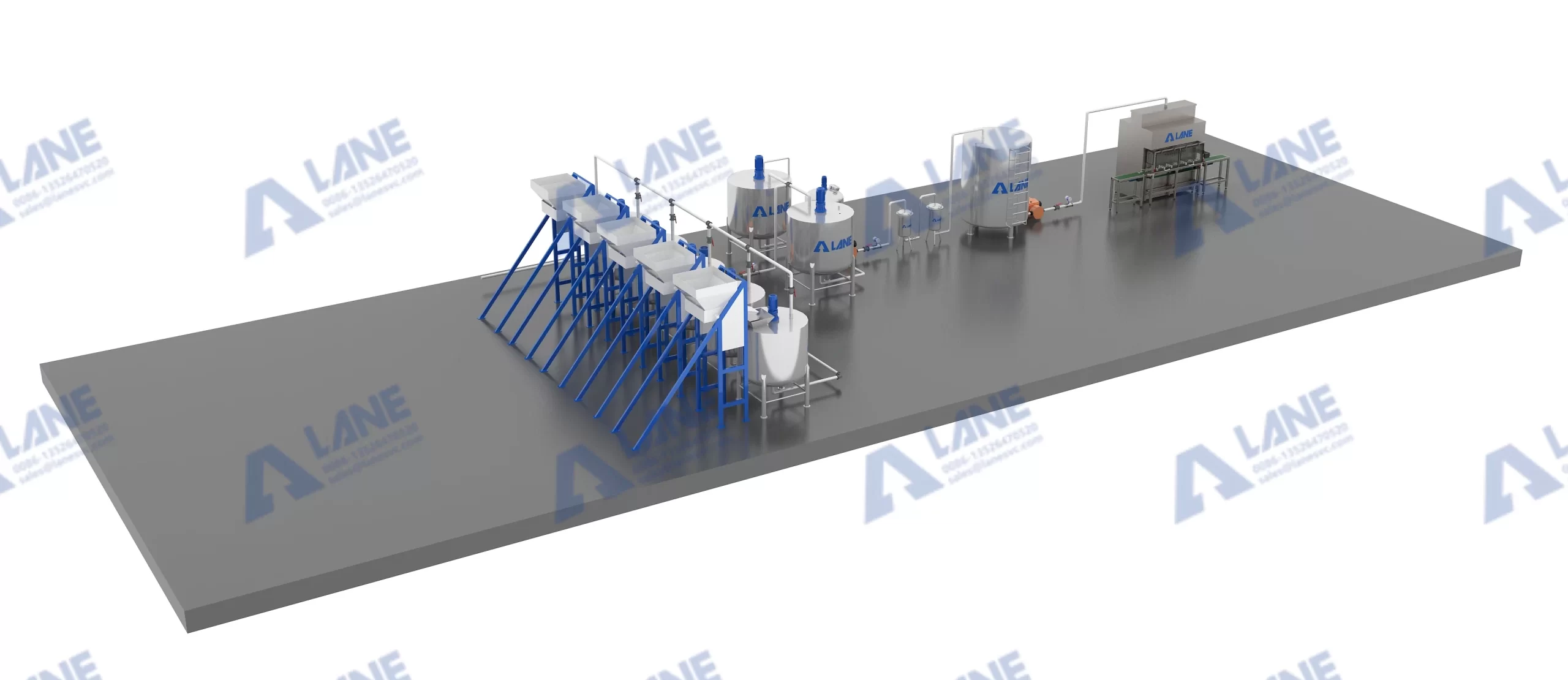
Engineering judgment: Do not calculate tank capacity from the daily production target alone. First determine the operating time of the upstream process, the filling rate, and how long the product needs to remain in storage.
LANE’s published product is a stainless steel storage tank designed for liquid storage. One construction detail deserves particular attention: the product page describes an arc transition at the inner-wall transition section to reduce dead corners.
This is relevant to fertilizer manufacturing because residue can collect around poorly designed internal transitions, especially when the stored liquid contains suspended particles or forms deposits during standing. Areas that are difficult to reach also make cleaning and inspection less convenient.
The product page identifies the following tank components:
These components form the basic interface between the vessel and the plant’s operating system. However, buyers should not assume that every accessory is included in every quotation. Confirm the actual supply scope, connection sizes, valve specifications, and instrument arrangement.
The page also describes optional equipment such as submersible mixers and pumping systems. This matters when the formulation contains suspended solids or tends to settle during storage. A plain storage vessel and an agitated holding vessel perform different duties.
My recommendation: Treat internal geometry and cleanability as purchasing criteria, not cosmetic details. A low-cost vessel that leaves inaccessible residue may create recurring cleaning work and product losses over its service life.
LANE’s product page lists models from 1,000 L to 100,000 L. The following table reproduces the published capacity and dimensional information.
| Nominal volume (L) | Inner diameter (mm) | Overall height (mm) | Cylindrical height (mm) |
|---|---|---|---|
| 1,000 | 930 | 2,200 | 1,500 |
| 2,000 | 1,270 | 2,600 | 1,610 |
| 3,000 | 1,400 | 2,900 | 2,000 |
| 4,000 | 1,600 | 3,100 | 2,000 |
| 5,000 | 1,600 | 3,700 | 2,440 |
| 10,000 | 1,900 | 5,050 | 3,660 |
| 15,000 | 2,000 | 5,950 | 4,880 |
| 20,000 | 2,230 | 6,100 | 5,110 |
| 25,000 | 2,650 | 5,600 | 4,500 |
| 30,000 | 2,600 | 6,760 | 5,500 |
| 40,000 | 2,900 | 7,400 | 6,100 |
| 50,000 | 3,200 | 7,600 | 6,100 |
| 60,000 | 3,300 | 8,350 | 6,000 |
| 70,000 | 3,500 | 8,200 | 7,320 |
| 80,000 | 3,800 | 8,300 | 7,320 |
| 90,000 | 3,800 | 9,200 | 7,880 |
| 100,000 | 3,800 | 9,900 | 8,720 |
These are the dimensions and nominal volumes published on the product page. They should be treated as reference model specifications, not as confirmation that every tank has the same wall thickness, pressure rating, or accessory package.
How should you use the capacity table?
Start with the volume produced per batch and the required storage buffer. Then consider how frequently the filling machine can empty the tank. For example, a plant producing several batches before packaging may need more buffer capacity than a plant filling continuously.
Do not automatically select the largest available vessel. A larger tank occupies more floor space and may leave a substantial amount of product sitting between production runs. The working volume should also allow for operating headspace and the actual filling and transfer arrangement.
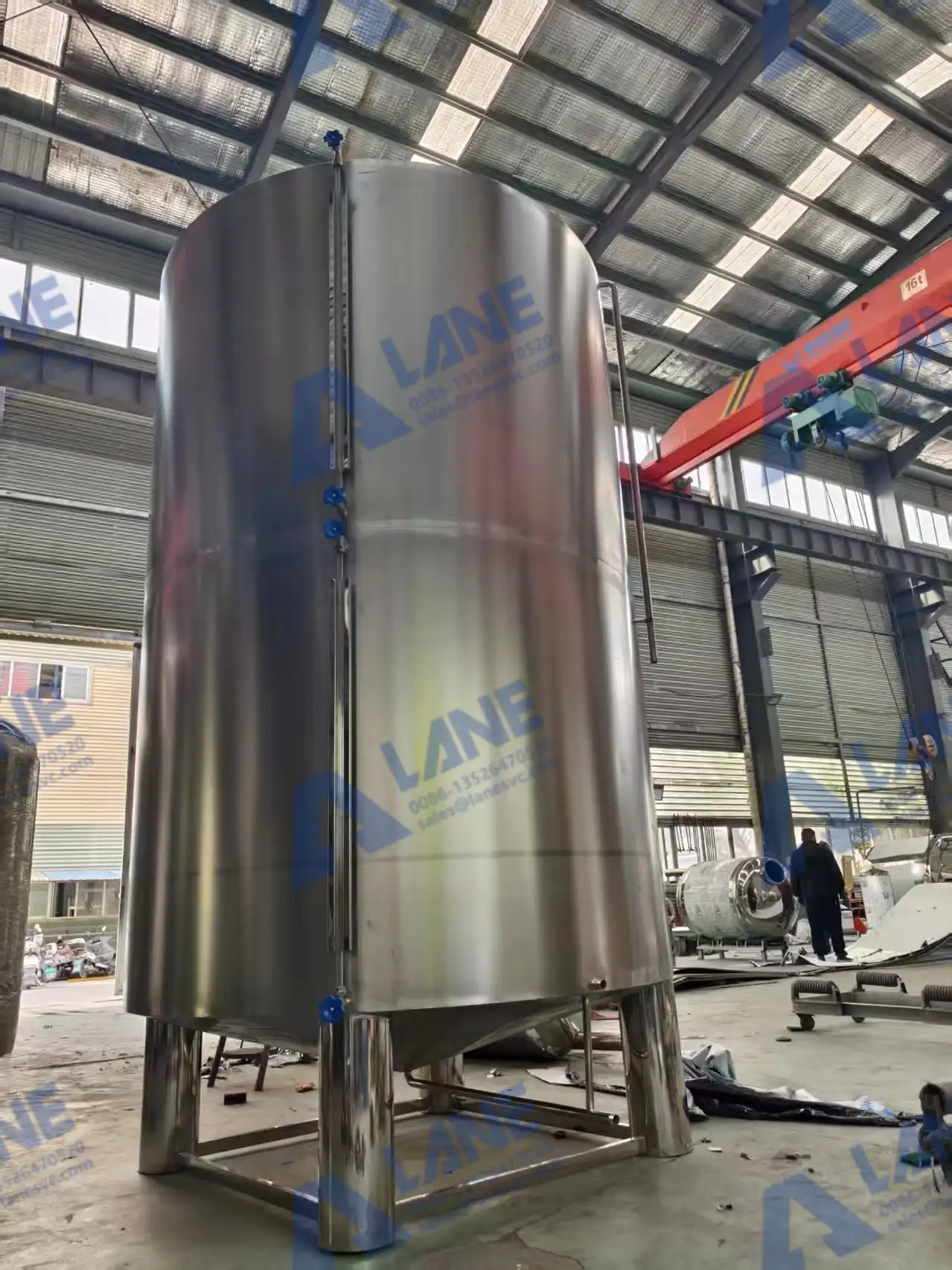
Stainless steel is the material stated on LANE’s product page, but the exact stainless steel grade is not specified in the published specification. Buyers should therefore request confirmation of the grade and the material used for every product-contact component.
Purdue University Extension’s technical guidance on steel tanks for storing and transporting pesticides and fertilizers discusses the use of 304 and 316 stainless steel in fertilizer storage applications. It also points out that highly acidic liquids and certain chemical compositions can still damage stainless steel, making material selection dependent on the stored product rather than the material name alone.
This is particularly important for liquid fertilizers containing acidic ingredients, salts, or other potentially corrosive components. Corrosion resistance depends on the chemical composition, concentration, temperature, and exposure time. A general description such as “stainless steel” is not enough to approve a vessel for every formulation.
The Nickel Institute’s technical reference on stainless steel corrosion resistance explains how chloride solutions, acids, temperature, and operating conditions affect the corrosion behavior of austenitic stainless steels. For fertilizer manufacturers, this reinforces the need to check the complete formulation and operating temperature before approving the tank material.
Before ordering, confirm:
The arc transition described by LANE is a useful design point, but it does not replace a full internal-finish specification. Ask for photographs or drawings of the internal welds, bottom outlet, and cleaning access.
Not every storage vessel needs continuous agitation. The decision depends on whether the stored formulation remains homogeneous during the expected holding period.
A fully dissolved liquid fertilizer may not require the same mixing arrangement as a suspension fertilizer containing insoluble particles. If solids settle quickly, a tank without suitable agitation may deliver different concentrations at the beginning and end of discharge.

For a formulation that requires mixing, discuss the following with the equipment supplier:
LANE’s product page mentions submersible mixers as possible accessories, but does not publish a standard motor power or mixing specification. These details must be selected according to the formulation and tank geometry.
Do not specify an agitator simply because it sounds safer. Unnecessary agitation adds motor power consumption and maintenance. The correct decision comes from a settling test or actual process experience with the formulation.
A useful quotation should describe more than the tank’s nominal volume. It should define the complete vessel configuration and the boundary between the tank supplier’s work and the buyer’s installation work.
| Item to confirm | Questions to ask the supplier | Why it matters |
|---|---|---|
| Tank capacity | Is the listed volume nominal or usable working volume? | Prevents a mismatch between production and storage requirements |
| Material | Which stainless steel grade is used for wetted parts? | Establishes chemical compatibility |
| Wall construction | What are the shell and bottom thicknesses? | Allows engineering review of structural suitability |
| Connections | What are the inlet, outlet, drain, and overflow sizes? | Avoids piping modifications during installation |
| Accessories | Are the level gauge, safety valve, manhole, and cleaning port included? | Clarifies the actual supply scope |
| Mixing system | Is an agitator required, and what are its specifications? | Prevents settling or unnecessary power consumption |
| Documentation | Are drawings, material details, and inspection records supplied? | Supports installation and acceptance |
Planning a fertilizer project? Contact LANE engineering team to get a free 3D plant layout drawing, motor power calculation, and factory-direct quote within 4 hours. Request 3D Layout & Budget Estimate →
The tank’s inlet and outlet arrangement should be finalized together with the plant piping layout. A vessel may have sufficient capacity but still cause operational problems if the outlet is positioned poorly, the transfer pump is undersized, or the filling line cannot draw product at the required rate.
For a typical liquid fertilizer line, the storage section may receive filtered liquid and supply an automatic filling machine. The piping design should account for:
The LANE stainless steel storage tank page provides the listed tank models and basic construction details. For a complete system, the tank should be reviewed alongside the liquid fertilizer production line rather than quoted as an isolated item.
The final layout should also leave enough clearance for manhole access, external inspection, pump maintenance, and future pipework changes.
The first mistake is choosing by nominal capacity alone. The nominal volume does not tell you the usable operating volume, the available headspace, or whether the tank can keep up with the filling section.
The second is accepting a generic material description. Stainless steel grade, weld quality, internal finish, and chemical compatibility all matter. These should be documented before production, not discussed after the tank arrives.
The third is assuming that accessories are included because they appear in a product description. A level gauge, safety valve, mixer, pump, and control instruments may be separate options. Ask for an itemized supply list.
Finally, buyers sometimes overlook transport and installation. Large-capacity tanks require a review of shipping dimensions, unloading equipment, access roads, foundation conditions, and the possibility of site assembly. A tank that fits the process calculation may still be unsuitable for the available installation route.
LANE’s published model table covers capacities from 1,000 L to 100,000 L. The listed dimensions vary by model, so buyers should confirm the selected tank’s overall dimensions and installation requirements before ordering.
No, not automatically. Suitability depends on the fertilizer’s chemical composition, concentration, temperature, and storage conditions. Confirm the exact stainless steel grade and wetted-part materials against the actual formulation.
No, not in every application. Fully dissolved products may not require continuous agitation, while suspension formulations may need mixing to limit settling. The decision should be based on formulation stability and the expected storage period.
The actual delivery time depends on tank capacity, customization, manufacturing schedule, and shipping arrangements. Ask the supplier to confirm the production lead time, packing dimensions, loading method, and estimated shipping schedule in the quotation.
At minimum, request installation drawings, connection details, cleaning instructions, inspection requirements, and a spare-parts recommendation. LANE’s website describes remote technical guidance and on-site installation guidance as available services; confirm the scope and cost for the destination project before ordering.
A suitable liquid fertilizer storage tank should match the formulation, storage duty, and production-line operating rhythm. Before approving a purchase, focus on three points:
These checks are more useful than comparing tank prices by nominal volume alone. They help prevent costly modifications after delivery and reduce the risk of interruptions once the production line is operating.
For a tank configured around your liquid fertilizer formulation and plant layout, contact LANE with your required capacity, product composition, storage duration, and filling rate.
For more details, please feel free to contact us.
Henan Lane Heavy Industry Machinery Technology Co., Ltd.
Email: sales@lanesvc.com
Contact number: +86 13526470520
WhatsApp: +86 13526470520
Leave a Comment
Latest Posts
LANE has more than 500 successful cases and is committed to providing customers with first-class solutions, high-end machinery and equipment, and one-stop pre-sales, sales and after-sales comprehensive customer service.