
Liquid Fertilizer Filtration System: Buyer’s Guide
A liquid fertilizer filtration system does more than remove visible particles. It protects transfer pumps, dosing equipment, filling machines, and downstream application systems from undissolved solids, sediment, and foreign contaminants. For fertilizer manufacturers, poor filtration can mean repeated shutdowns, inconsistent product appearance, blocked nozzles, and higher maintenance costs.
The purchasing mistake is often simple: choosing a filter by mesh size or price before understanding the liquid being processed. A clear NPK solution, an organic fertilizer extract, and a suspension fertilizer do not place the same demands on filtration equipment.
This guide is written for plant owners, production managers, and procurement teams who need to select a filtration solution that matches their actual formulation and operating conditions.

The main purpose of a liquid fertilizer filtration system is to separate unwanted solid material from the product before it reaches sensitive equipment or final packaging. These solids may include undissolved raw materials, foreign particles, rust, precipitates, and residues generated during mixing or processing.
Not every particle has the same source. Some enter with raw materials; others form because of incomplete dissolution, incompatible ingredients, temperature changes, or chemical reactions. Organic liquid fertilizers may also contain fibrous matter and suspended biological residues.
For a manufacturer, the consequences are practical:
One point is often overlooked: filtration cannot correct an unstable fertilizer formula. If dissolved nutrients precipitate after mixing, simply installing a finer filter may increase filter loading without solving the underlying chemical problem. UF/IFAS identifies both physical particles and chemical precipitation as causes of fertigation clogging.
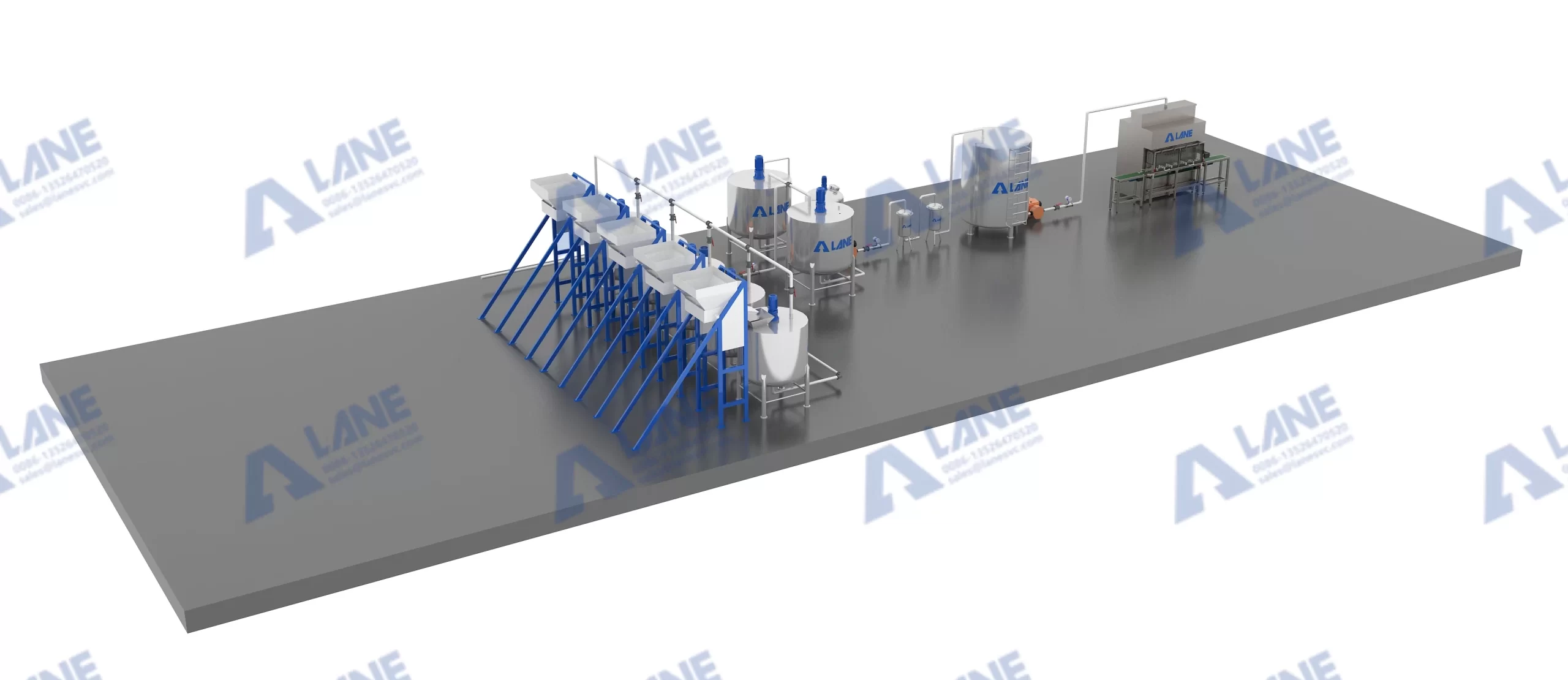
In a typical liquid fertilizer production line, filtration takes place after the main mixing, dissolution, or reaction stage and before finished-product storage or packaging. The exact position depends on the formulation and whether the plant uses batch or continuous production.
A common process arrangement is:
A liquid fertilizer filtration system may use one filtration stage or several stages. A coarse filter can capture larger residues, while a finer bag or cartridge filter can provide additional polishing. The objective is not to achieve the smallest possible particle rating. It is to achieve the required product cleanliness at a sustainable flow rate.
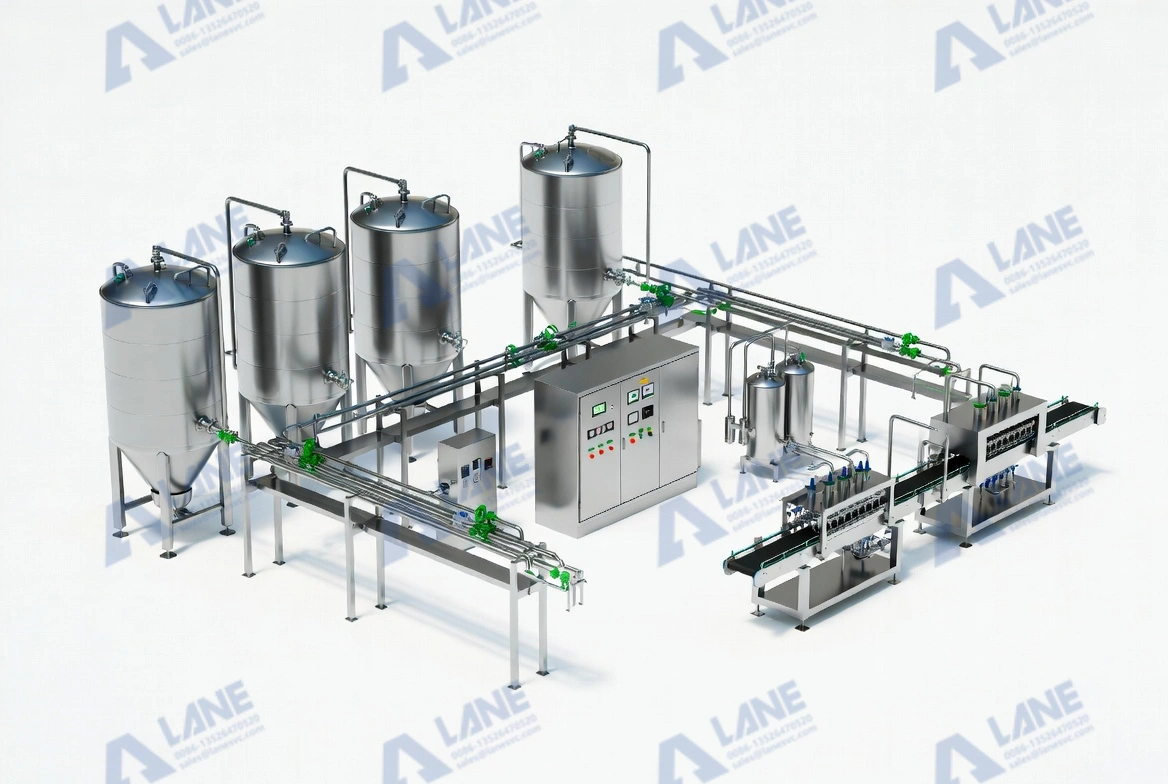
LANE’s liquid fertilizer production line information lists filters alongside mixing machines, reactor tanks, industrial pumps, pipelines, storage tanks, and filling equipment. This reflects an important engineering principle: filtration should be specified as part of the complete process, not purchased as an isolated accessory.
The right filter depends on the liquid’s viscosity, solids concentration, particle characteristics, required clarity, and cleaning frequency. Buyers should compare the operating behavior of each option rather than focus only on its advertised filtration accuracy.
A bag filter is commonly used for removing suspended particles and undissolved residues. Liquid enters the filter housing, passes through the filter bag, and leaves the unit after particles are retained by the media.
It is worth considering when the product contains a moderate solids load and the operator can replace or clean filter bags as part of routine maintenance. The filter housing, bag material, sealing arrangement, and available filtration area all matter.
A cartridge filter is generally considered when finer filtration or a more controlled final filtration stage is required. It can be used after coarse filtration to capture smaller particles that pass through the first stage.
However, finer media can load quickly if the upstream liquid contains too much sediment. Installing a cartridge filter without a suitable pre-filtration stage may increase consumable costs and reduce production availability.
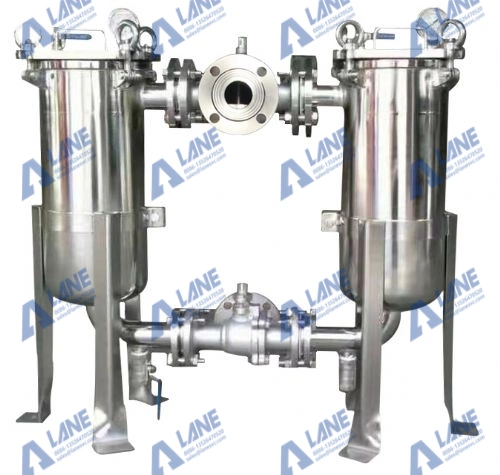
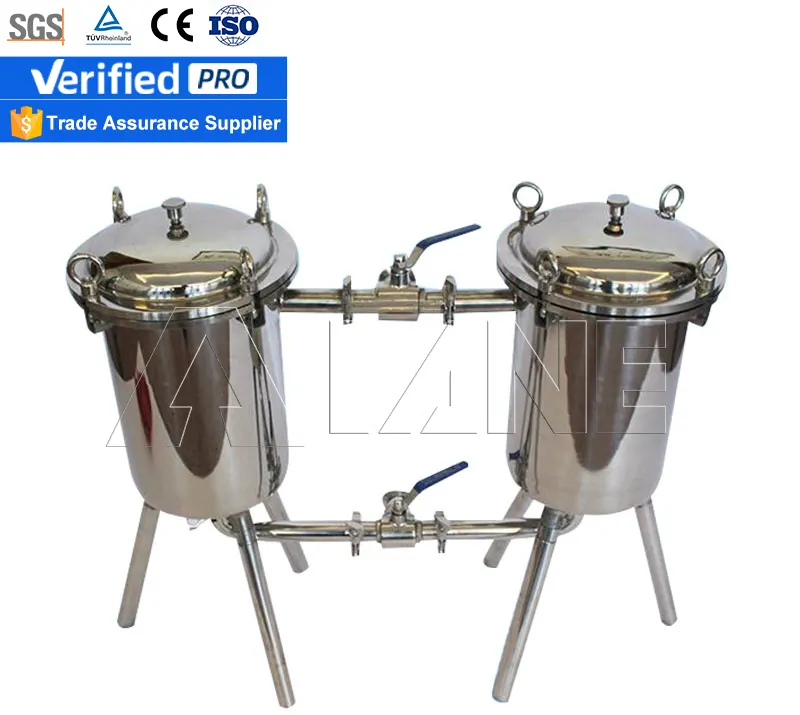
A duplex filter uses two filter chambers. During operation, one chamber can remain in service while the other is isolated for cleaning or filter-element replacement, depending on the system design and valve arrangement.
This is useful when a production line needs to reduce interruptions during filter maintenance. LANE’s website lists a Dual Filter among its liquid fertilizer equipment and describes its batch production line as using a two-chamber filter for continuous filtration operation.
Automatic cleaning can reduce manual intervention where the incoming liquid has a predictable solids load and the cleaning mechanism is compatible with the material being filtered. It should not be treated as a universal solution: sticky organic residues, fibrous material, or chemical deposits may require a different cleaning strategy.
Buyer’s judgment: A duplex filter is worth evaluating when production continuity is important. A bag or cartridge filter may be more economical for smaller batches or products with low solids content. The final decision should follow a filtration test using the actual fertilizer sample.
A supplier quotation should not simply state a filter model and a micron rating. The buyer needs enough information to determine whether the equipment can handle the actual liquid at the required production rate.
The most important parameters include:
The following table gives a practical buyer’s checklist. The filtration ratings are examples for preliminary discussion, not universal recommendations for every fertilizer formulation.
| Parameter | What to Specify | Buyer’s Check |
|---|---|---|
| Flow rate | Required m³/h or L/min | Confirm actual peak flow, not only average output |
| Filter rating | Example: 100 μm or 50 μm | Confirm whether the rating is nominal or absolute |
| Operating pressure | Normal and maximum bar | Check housing and seal pressure limits |
| Differential pressure | Clean and service-limit values | Request gauge or transmitter arrangement |
| Wetted material | SS304, SS316L, or compatible alternatives | Verify against pH, salts, acids, and additives |
| Liquid viscosity | Value at operating temperature | Check pump and filter capacity at this viscosity |
| Solids loading | Particle size and approximate concentration | Provide a representative product sample |
| Cleaning | Manual, duplex switching, or automatic | Confirm cleaning time and production interruption |
ISO 3968 provides a method for evaluating differential pressure against flow in hydraulic filters. Although it is not a fertilizer-specific filter sizing standard, it supports the practice of requesting pressure-drop data at stated flow conditions rather than accepting an unsupported capacity claim.
A liquid fertilizer filtration system should be selected according to product type. A clear soluble fertilizer and an organic suspension should not be expected to perform well with an identical filtration arrangement.
| Product Type | Typical Filtration Concern | Configuration to Evaluate |
|---|---|---|
| Clear Liquid NPK | Undissolved salts and foreign particles | Bag filter or duplex filter |
| Water-Soluble Fertilizer Solution | Fine undissolved material | Coarse filtration followed by cartridge filtration if required |
| Organic Liquid Fertilizer | Fibers, organic residues, and variable solids | Solid-liquid separation followed by suitable polishing filtration |
| Suspension Fertilizer | Intentional suspended solids and settling | Process-specific separation; avoid removing desired product solids |
| Micronutrient Liquid | Fine particles and possible precipitation | Formulation compatibility test plus suitable final filtration |
For organic products, preliminary solid-liquid separation may be necessary before final filtration. LANE’s published process description for liquid fertilizer production in Southeast Asia identifies solid-liquid separation and filter press or centrifuge treatment as possible equipment for separating residues from the liquid fraction.
A common mistake is to filter a suspension fertilizer as if it were a clear solution. The filter may remove particles that are part of the intended formulation, changing the product’s nutrient content or physical properties. The supplier must understand whether the solids are contaminants or functional ingredients before recommending a filter.
Frequent blockage is not always evidence that the filter is too small. It may indicate incomplete dissolution, poor raw-material quality, incompatible ingredients, excessive solids loading, or unsuitable operating conditions.
Common causes include:
A practical liquid fertilizer filtration system should include a way to monitor pressure before and after the filter. When differential pressure rises, operators can determine whether the filter is loading and whether cleaning or element replacement is required.
UF/IFAS guidance on fertigation emphasizes the role of water quality, chemical compatibility, and maintenance in preventing clogging. It also recommends compatibility checks such as jar tests before mixing fertilizer solutions for use in irrigation systems.
My recommendation is to investigate the material causing blockage before simply installing a finer filter. If the solids are caused by precipitation, correct the formulation or mixing conditions first. Otherwise, the plant may spend more on filter elements while the underlying problem remains.
A reliable quotation should describe the operating conditions and the equipment scope clearly. Asking only for a price per filter makes it difficult to compare suppliers on an equal basis.
Before requesting a quotation, prepare:
Ask the supplier to confirm the rated flow under your actual viscosity, provide the filter element specification, explain the cleaning procedure, and identify all wetted materials. If the product is difficult to filter, request a trial with a representative sample before finalizing the design.
LANE’s liquid fertilizer equipment website presents the Dual Filter and complete production-line equipment. Buyers evaluating a liquid fertilizer filtration system can use this as a starting point for discussing a filtration unit integrated with the mixing, pumping, storage, and filling stages.
1. What is the main function of a liquid fertilizer filtration system?
Its main function is to remove unwanted solid particles and residues from liquid fertilizer before storage, filling, or downstream use. The required filtration level depends on the product and the equipment it will supply.
2. Is a bag filter suitable for liquid fertilizer?
Yes, a bag filter can be suitable for removing suspended particles and undissolved residues. Its suitability depends on solids loading, viscosity, chemical compatibility, and the required filtration rating.
3. What is the advantage of a duplex filter?
A duplex filter allows one chamber to operate while the other is isolated for cleaning or element replacement, when configured with suitable valves. This can reduce production interruptions compared with a single-chamber arrangement.
4. What micron rating should I choose?
There is no universal micron rating for all liquid fertilizers. The correct rating depends on particle size, product clarity requirements, downstream equipment, and the filter’s available area and flow capacity.
5. Can a filtration system remove dissolved salts?
No. Conventional mechanical filtration removes suspended or undissolved solids, not salts that are fully dissolved in the liquid. Dissolved components require a different separation or treatment process.
6. Why does my liquid fertilizer filter clog frequently?
Frequent clogging can result from high solids loading, incomplete dissolution, precipitation, organic residues, or an undersized filter. Check the retained material and the product chemistry before changing the filter rating.
7. Does an organic liquid fertilizer need a different filter?
Often, yes. Organic liquids may contain fibers, biological residues, and variable suspended solids. A preliminary separator or centrifuge may be needed before final filtration, depending on the feedstock.
8. Can the filtration unit be integrated into a complete liquid fertilizer production line?
Yes. A filtration unit can be integrated with mixing tanks, reactors, transfer pumps, storage tanks, and filling equipment. Its capacity and connection points should be coordinated with the rest of the line during engineering design.
The right liquid fertilizer filtration system is not necessarily the one with the finest filter element or the highest advertised flow rate. It is the one that handles the actual fertilizer formulation, maintains the required throughput, protects downstream equipment, and can be cleaned without creating unnecessary production losses.
Before purchasing, confirm the product’s solids characteristics, viscosity, required filtration rating, operating pressure, and cleaning method. Ask for a sample-based filtration test and a clear equipment specification instead of relying on a generic model recommendation.
For manufacturers planning a new line or upgrading an existing one, explore LANE’s liquid fertilizer production equipment and liquid fertilizer production line. You can also review the company’s broader fertilizer equipment solutions or LANE Machinery for additional equipment and engineering information.
A useful quotation should start with your product sample, production target, and process requirements. That is the basis for selecting a filter that works in the plant—not just on a specification sheet.
Leave a Comment
Latest Posts
LANE has more than 500 successful cases and is committed to providing customers with first-class solutions, high-end machinery and equipment, and one-stop pre-sales, sales and after-sales comprehensive customer service.