
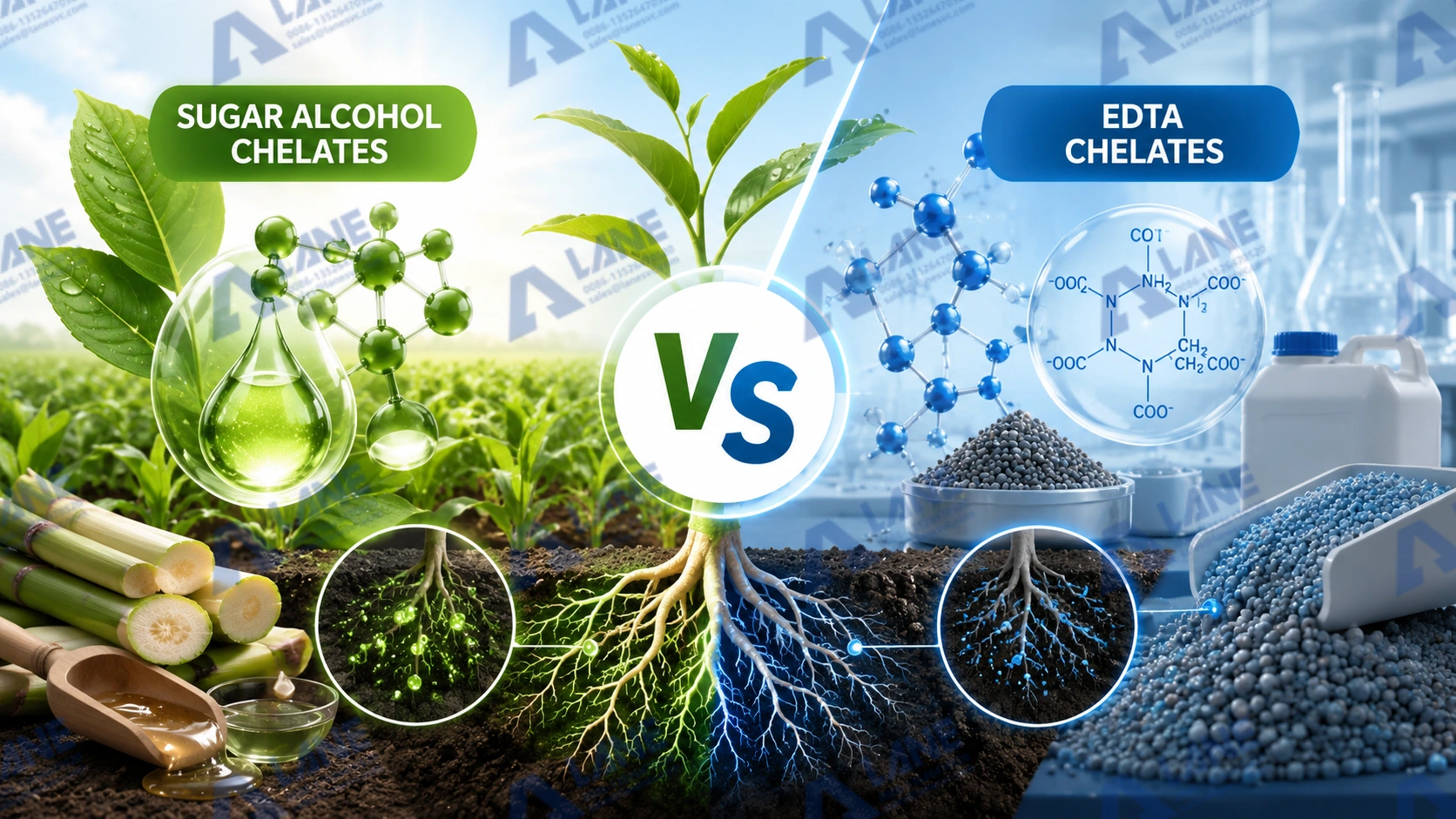
Sugar Alcohol vs EDTA Chelates: Which Micronutrient Delivery System is Superior?
Micronutrients are essential for healthy crop development. These nutrients help improve photosynthesis, enzyme activation, and stronger resistance to environmental stress. However, micronutrients such as iron, zinc, manganese, copper, boron, and magnesium are often difficult for plants to absorb efficiently due to soil pH, fixation, and nutrient antagonism. Chelation “claws” micronutrients, shielding them from soil reactions and boosting bioavailability. Among many options, EDTA and the newer, bio-based sugar alcohol chelates are the most talked about chelates. The “sugar alcohol vs EDTA chelates” debate is now shaping decisions on fertilizer production lines across various production systems.
Chelated micronutrients enhance plant uptake by binding metals like iron, zinc, and manganese to organic agents and prevent soil fixation. The ongoing debate of sugar alcohol vs EDTA chelates has become increasingly important in modern agriculture and fertilizer manufacturing. Sugar alcohol chelates offer natural, mobile delivery, while EDTA chelates provide stability. Both technologies are designed to improve micronutrient availability, but they differ significantly in molecular structure, nutrient release mechanisms, environmental compatibility, and production requirements.
In this article, we compare sugar alcohol vs EDTA chelates from agronomic and manufacturing perspectives while introducing advanced fertilizer machinery solutions from LANE Heavy Industry for producing high-quality chelated micronutrient fertilizers.
Sugar alcohol chelates are micronutrient complexes formed by combining trace elements with sugar alcohol compounds such as sorbitol, mannitol, xylitol, or other polyols. These compounds provide multiple hydroxyl groups that bind micronutrients while maintaining excellent water solubility and plant compatibility.
Key features of sugar alcohol chelates:
In the sugar alcohol vs EDTA chelates discussion, sugar alcohol chelates are often preferred for foliar sprays because plants can quickly absorb both the micronutrient and carbon-based ligand.
In soil solution, essential micronutrients such as iron, zinc, copper, and manganese exist as positively charged cations. These ions are chemically reactive and prone to forming insoluble precipitates. Iron converts to rust-like hydroxides, while phosphates lock up zinc in forms roots cannot absorb. A chelating agent acts as a molecular claw. They wrap around the metal ion to form a stable, soluble ring structure that resists these unwanted reactions.
The performance of a chelate is governed by its stability constant (how tightly it binds the nutrient), its behavior across pH ranges, and its fate in the environment after the nutrient is delivered. The sugar alcohol vs EDTA chelates debate is based on how widely they are used, their efficiency, crop yield, and quality.
Sugar Alcohol Chelates: Nature’s Low-Molecular-Weight Solution
Sugar alcohol chelates are formed by reacting sugar alcohols such as sorbitol and mannitol with nutrient elements like calcium, magnesium, boron, iron, zinc, and copper. Sugar alcohols are naturally occurring compounds that plants themselves produce as initial products of photosynthesis. Plants directly absorb and utilize this type of chelate.
Key advantages of sugar alcohol chelates include:
In the sugar alcohol vs EDTA chelates debate, the above characteristics make sugar alcohol chelates valuable for foliar application in high-value horticultural crops, where rapid correction of calcium or boron deficiencies can prevent physiological disorders like blossom-end rot and bitter pit.
Ethylenediaminetetraacetic acid (EDTA) is the most universally known and widely used synthetic chelating agent in agricultural fertilizers. Its hexadentate structure forms extremely tight complexes with divalent and trivalent metal cations, making it effective at keeping nutrients soluble and plant-available.
Strengths of EDTA chelates:
Critical limitations:
In the sugar alcohol vs EDTA chelates debate, EDTA provides a cost-effective and proven solution to fertilizer manufacturers.
| Parameter | Sugar Alcohol Chelates | EDTA Chelates |
| Molecular Size | Small; rapid leaf penetration and translocation | Larger; slower uptake kinetics |
| pH Stability Range | Broad stability across pH conditions | Unstable above pH 6.5; requires acidic to neutral soils |
| Nutrient Utilization Rate | >80% foliar absorption efficiency | Variable; strongly pH-dependent |
| Environmental Fate | Readily biodegradable; no groundwater risk | Highly persistent; potential for groundwater contamination |
| Secondary Plant Benefits | Pathogen suppression, stress tolerance, carbon source for microbes | None beyond nutrient chelation |
| Cost per Unit | Higher initial cost | Most economical option |
| Best-Use Scenario | Foliar feeding, high-value crops, alkaline soils, stress conditions | Soil application in acidic to neutral soils, broad-acre crops |
For growers who operate on alkaline or calcareous soils, sugar alcohol chelates are the clear choice. For acidic soils with tight input budgets, EDTA remains a viable option, provided pH is carefully managed. This divergence in performance has direct implications for fertilizer manufacturing strategy.
Machinery from LANE Heavy Industry
LANE Heavy Industry leads in chelate production with turnkey plants for sugar alcohol and EDTA systems. Our jacketed reactor maintains 60-80°C for optimal bonding. Our production line also integrates evaporators for 50% solids concentration. For sugar alcohols, LANE’s vacuum distillation units purify mannitol streams, feeding into chelation towers.
LANE’s Stainless Steel Reaction Vessels are designed with high-torque agitation systems and automated temperature sensors. This ensures that the ligand (sugar alcohol or EDTA) and the metal salt achieve 100% chelation efficiency. For sugar alcohol complexes, which can be sensitive to overheating, our precise thermal jackets prevent degradation of the polyol chain.
The debate over sugar alcohol vs EDTA chelates reflects the evolution of fertilizer technology. EDTA remains cost-effective and reliable for traditional agriculture. However, sugar alcohol chelates offer superior absorption, sustainability, and premium market value.
Q1. What is the main difference between Sugar alcohol vs EDTA chelates?
Sugar alcohol chelates are organic-based and improve nutrient absorption, while EDTA chelates are synthetic and emphasize chemical stability.
Q2: Why is the price of Sugar Alcohol chelates often higher than EDTA?
A: The raw materials (high-purity polyols) and the specialized production process required to maintain the stability of the natural molecules are more costly. However, the lower application rates and higher efficiency often lead to a better Return on Investment (ROI) for the grower.
Q3: How does LANE Heavy Industry ensure the purity of the chelate?
A: Our reaction vessels feature advanced filtration stages and “dead-zone free” mixing blades, ensuring that no unreacted salts remain. Our PLC-controlled systems log every batch, providing full traceability for quality insurance.
Q4: Is EDTA harmful to the soil in the long run?
A: While not acutely toxic, EDTA is a “persistent” molecule. It does not break down easily and can mobilize heavy metals in the soil that weren’t intended for plant uptake. For sustainable and organic farming, sugar alcohols or amino acid chelates are preferred.
Q5. Are sugar alcohol chelates better for foliar fertilizer?
Yes. In Sugar alcohol vs EDTA chelates, sugar alcohol products generally provide faster foliar absorption and better mobility.
For more details, please feel free to contact us.
Henan Lane Heavy Industry Machinery Technology Co., Ltd.
Email: sales@lanesvc.com
Contact number: +86 13526470520
Whatsapp: +86 13526470520
Leave a Comment
Latest Posts
LANE has more than 500 successful cases and is committed to providing customers with first-class solutions, high-end machinery and equipment, and one-stop pre-sales, sales and after-sales comprehensive customer service.