
A Guide to the Commercial Nitrogen-Rich Liquid Fertilizer production for Vegetables and Application
Table of Contents
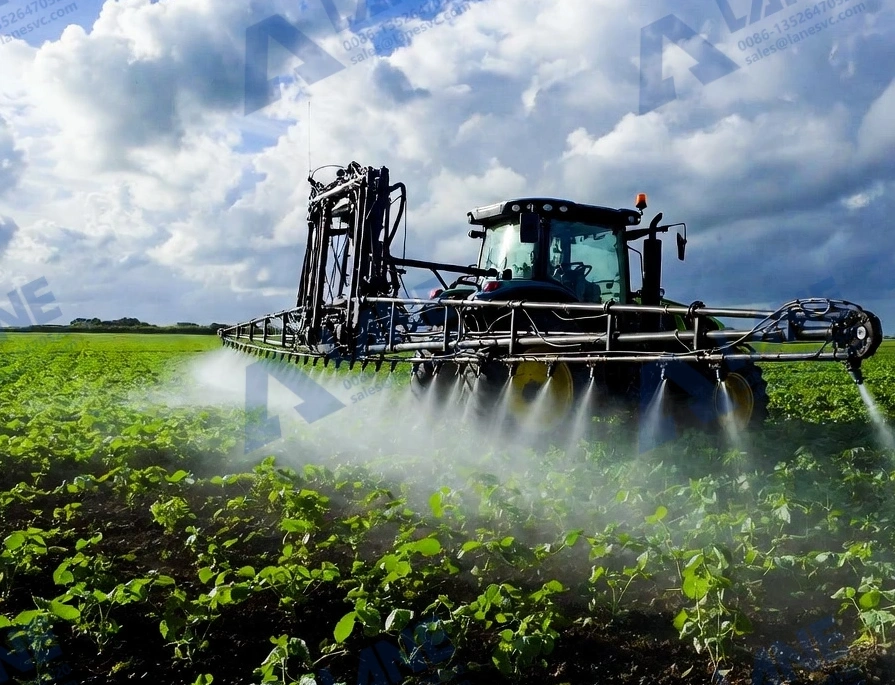
Nitrogen is one of the major essential nutrients for vegetable growth. It supports chlorophyll production, cell division, and leaf development. Nitrogen-rich liquid fertilizer production for vegetables has become critical for high-yield, high-quality vegetable cultivation. In the modern fertilizer system, nitrogen-rich liquid fertilizer production for vegetables offers faster nutrient absorption, precise application, and reduced environmental impact. For commercial producers and farmers, mastering nitrogen-rich liquid fertilizer production for vegetables helps you meet the growing demand for this premium quality fertilizer while helping farmers achieve fresh, nutrient-dense produce.
This guide explores the commercial production process of nitrogen-rich liquid fertilizer and the role of LANE Heavy Industry’s advanced production lines in streamlining nitrogen-rich liquid fertilizer production for vegetables.
Commercial nitrogen-rich liquid fertilizer production for vegetables requires manufacturers to maintain strict manufacturing standards. This is to make sure that the product is consistent, stable, and efficient. Commercial production lines incorporate advanced mixing technologies, filtration systems, and quality control protocols that guarantee each batch meets specified nutrient concentrations.
Henan LANE Heavy Industry Machinery Technology Co., Ltd. has established itself as a leader in the fertilizer machinery manufacturing field. We provide complete turnkey solutions for fertilizer manufacturers worldwide. With ISO and CE certifications and a 5-year warranty on equipment, LANE’s systems are designed for reliability and precision.
LANE Heavy Industry’s Production Line Overview
LANE Heavy Industry offers liquid fertilizer production lines capable of manufacturing nitrogen-rich liquid fertilizer for vegetables at capacities ranging from 1 to 20 tons per hour. These fully automated systems handle everything from raw material dissolution to final packaging. We ensure contamination-free production in a completely enclosed environment.
Our production line is versatile and can accommodate various nitrogen sources, including:
Key Equipment in the Production Process
A complete LANE nitrogen-rich liquid fertilizer production for vegetables line includes the following essential components:
| Equipment | Material | Function |
| Mixing Tank | Industrial stainless steel | Initial dissolution of nitrogen sources |
| Macromolecule Mixing Reactor | Stainless steel | Chemical reactions for complex formulations |
| Additive Mixing Tank | Stainless steel | Incorporation of micronutrients and stabilizers |
| Duplex Strainer Filter | Stainless steel | Removal of solid impurities |
| Storage Tank | Stainless steel | Temporary storage with temperature control |
| Automatic Filling Machine | Stainless steel | Precision packaging into containers |
The system features 6mm–8mm thick industrial-grade stainless steel construction throughout, ensuring durability and resistance to corrosive fertilizer materials.
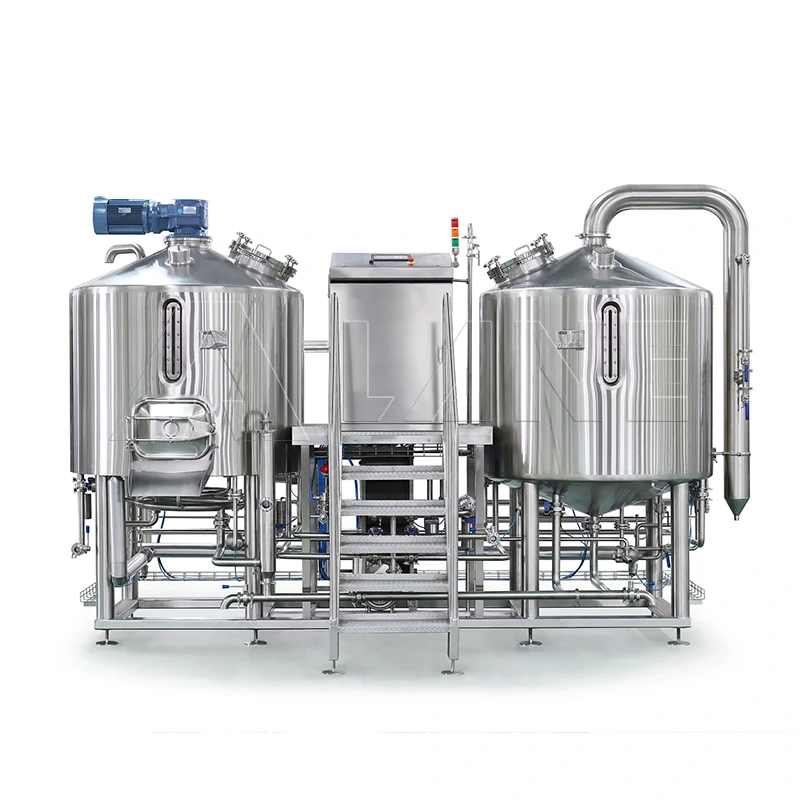
The commercial nitrogen-rich liquid fertilizer production for vegetables at LANE Heavy Industry follows a designed process:
Step 1: Raw Material Preparation
The first step is to prepare the raw materials. High-quality nitrogen sources, water (as solvent and carrier), emulsifiers, stabilizers, and pH regulators are prepared according to the formulation.
Step 2: Fertilizer Dissolution
Water-soluble nitrogen components are dissolved in water within the mixing tanks to create a homogeneous base solution.
Step 3: Macromolecule Mixing Reaction
For complex formulations, the base solution enters the macromolecule mixing reactor where chemical reactions may occur to form stable nitrogen compounds.
Step 4: Additive Incorporation
Secondary nutrients (phosphorus, potassium), micronutrients, and specialized additives like pH regulators are blended in the main mixing tank and additive mixing tank.
Step 5: Emulsification (if required)
For emulsified formulations, high-shear mixing combines the fertilizer solution with emulsifiers to create stable emulsions that improve nutrient absorption.
Step 6: Filtration and Refining
The liquid mixture passes through the duplex strainers to remove any solid particles or impurities. This ensures the final product’s purity and removes any impurities.
Step 7: Quality Control Testing
Samples are analyzed to verify nitrogen content, pH, stability, and other critical parameters.
Step 8: Storage and Packaging
Approved product moves to storage tanks before automatic filling into containers ranging from small bottles to bulk totes.
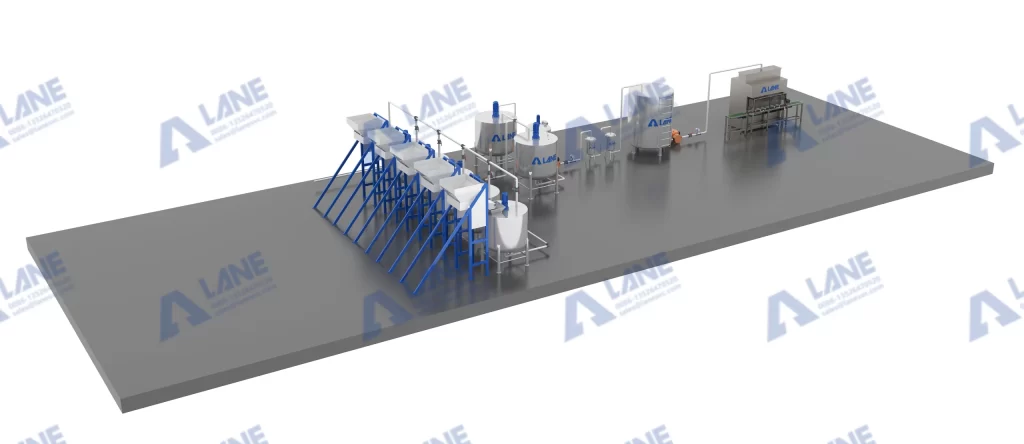
Maintaining consistent quality in nitrogen-rich liquid fertilizer production for vegetables requires testing throughout the manufacturing process. LANE’s production lines incorporate several quality assurance features:
These measures ensure that every batch of fertilizer meets the labeled nutrient guarantees and performs reliably in the field.
Application Methods for Vegetable Crops
Nitrogen-rich liquid fertilizer for vegetables can be applied through several methods depending on the crop type, growth stage, and farming system:
Proper application rates are essential for maximizing the benefits of nitrogen-rich liquid fertilizer for vegetables. Based on industry recommendations, the following guidelines apply:
| Vegetable Type | Application Method | Dosage Rate | Timing |
| Leafy vegetables (lettuce, spinach) | Foliar | 10-30 L/ha | Vegetative development |
| Fruiting vegetables (tomatoes, peppers) | Foliar | 3-6 L/ha | Establishment and vegetative growth (2-3 times) |
| Brassicas (broccoli, cauliflower) | Foliar | 3-6 L/ha | Vegetative growth (3-4 times) |
| Onions, garlic | Foliar | 3-6 L/ha | From 2-3 leaves up to 8-9 leaves |
| Protected crops (greenhouse) | Fertigation | 4-5 kg/1000 m² | Vegetative development |
For concentrated products, application rates of 10-15 L/ha are recommended for vegetables like calabrese and spinach, with repeat applications at 10–14-day intervals as needed.
Always follow the package instructions.
Q1: What makes LANE Heavy Industry’s production line suitable for nitrogen-rich liquid fertilizer production for vegetables?
LANE’s production lines feature stainless steel construction, automated mixing systems, and customizable formulations that ensure consistent nitrogen-rich liquid fertilizer production for vegetables. The equipment is designed to handle various nitrogen sources and can produce formulations tailored to specific vegetable crop requirements. With capacities from 1-20 tons per hour and 5-year warranties, LANE provides reliable solutions for commercial manufacturers.
Q2: What raw materials are needed for nitrogen-rich liquid fertilizer production for vegetables?
Primary raw materials include water (as solvent), nitrogen sources (urea, ammonium nitrate, potassium nitrate, or amino acids), and optional additives such as emulsifiers, stabilizers, pH regulators, and micronutrients. For emulsified formulations, specialized emulsifiers ensure even distribution for better plant absorption.
Q3: How do I choose the right production line capacity?
Consider your target market, available raw materials, and expected production volume. LANE offers lines producing 1-20 tons per hour. For commercial operations supplying regional vegetable farmers, a 1-5 ton/hour line may suffice, while larger operations serving broader markets may require 10+ ton/hour capacity.
Q4: What quality certifications do LANE production lines hold?
All LANE equipment passes ISO and CE certification, with a 5-year warranty after shipment. The company is an audited supplier with SGS/BV profile certification.
Q5: Can the same production line make different nitrogen fertilizer formulations?
Yes, LANE’s production lines are designed for flexibility. The automated control systems allow formulation adjustments to produce various nitrogen-rich liquid fertilizers for vegetables, including straight nitrogen products, NPK blends, and formulations with micronutrients.
Q6: What is the ideal timing for applying nitrogen-rich liquid fertilizers to vegetables?
For most vegetables, applications during vegetative growth stages are most beneficial. Leafy vegetables benefit from applications throughout development, while fruiting vegetables typically receive 2-3 applications from establishment through early fruiting.
Q7: How should nitrogen-rich liquid fertilizers be stored after production?
Store in stainless steel or approved plastic containers in a cool, dry location away from direct sunlight. Temperature control may be necessary for certain formulations. LANE’s production lines include storage tanks with temperature monitoring capabilities.
Q8: What support does LANE provide for new production line installations?
LANE offers comprehensive support including remote video guidance, on-site installation instruction by engineers, worker training, and field testing of the production line. The company provides one-stop pre-sales, in-sales, and after-sales service
For more details, please feel free to contact us.
Henan Lane Heavy Industry Machinery Technology Co., Ltd.
Email: sales@lanesvc.com
Contact number: +86 13526470520
Whatsapp: +86 13526470520
Leave a Comment
Latest Posts
LANE has more than 500 successful cases and is committed to providing customers with first-class solutions, high-end machinery and equipment, and one-stop pre-sales, sales and after-sales comprehensive customer service.