
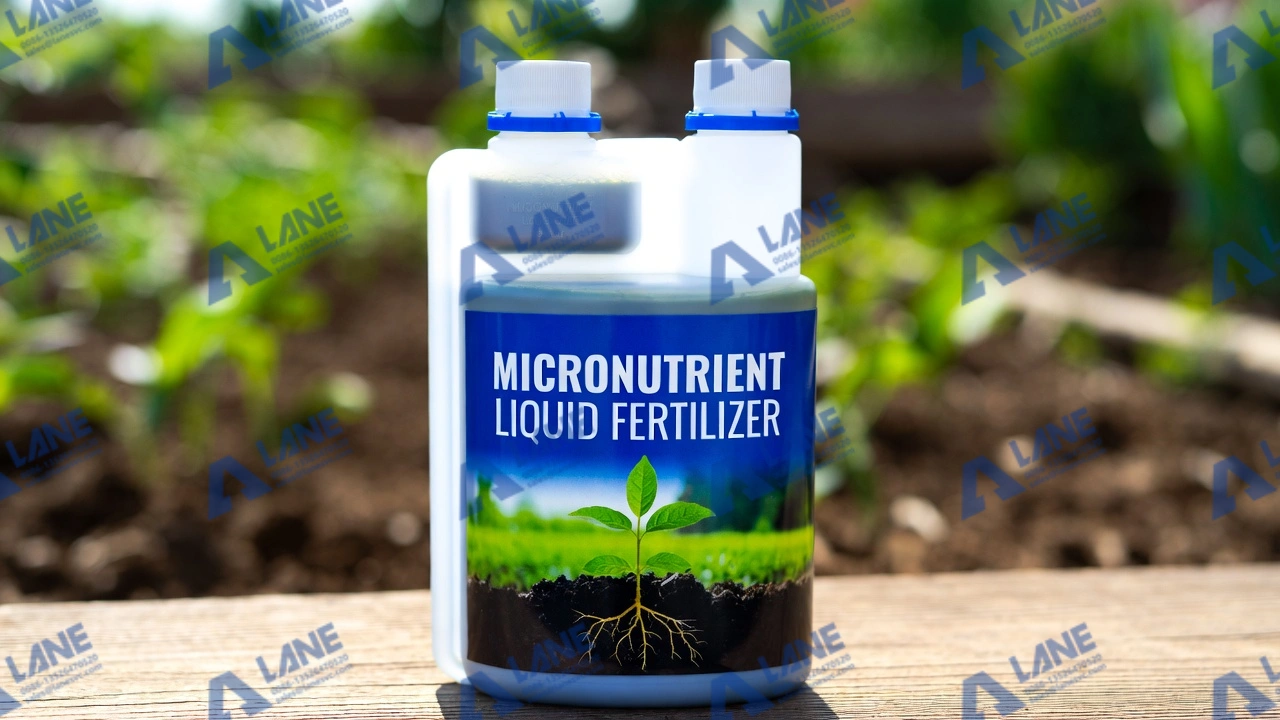
7 Common Formulation Challenges in Micronutrient Liquid Fertilizer Production (And How to Solve Them)
Table of Content
Micronutrient Liquid Fertilizer provides essential trace elements (such as iron, zinc, manganese, and boron) that crops need for healthy growth, high yield, and quality improvement. Micronutrient Liquid Fertilizer offers faster absorption, higher utilization rate, and easier application. This makes it popular among farmers and agricultural enterprises. However, the production of micronutrient liquid fertilizer presents some unique chemical and mechanical challenges that manufacturers must overcome.
Micronutrient liquid fertilizer formulations require precision, stability, and consistency. These qualities depend heavily on your production line capabilities. This article focuses on the 7 most common formulation challenges in Micronutrient Liquid Fertilizer production and highlights how LANE Heavy Industry’s production machinery can help enterprises overcome these obstacles smoothly.
The Problem
When producing micronutrient liquid fertilizer, one of the most common and frustrating issues is the formation of precipitates. Certain chemical salts are incompatible when concentrated, for example calcium with phosphates or sulfates. As the University of Arkansas Extension explains, “Common precipitates that can occur include CaSO₄ and CaPO₄. These precipitates form more readily under high pH.” Once these precipitates form, they clog injectors, create uneven nutrient distribution, and become unavailable to plants.
The Solution
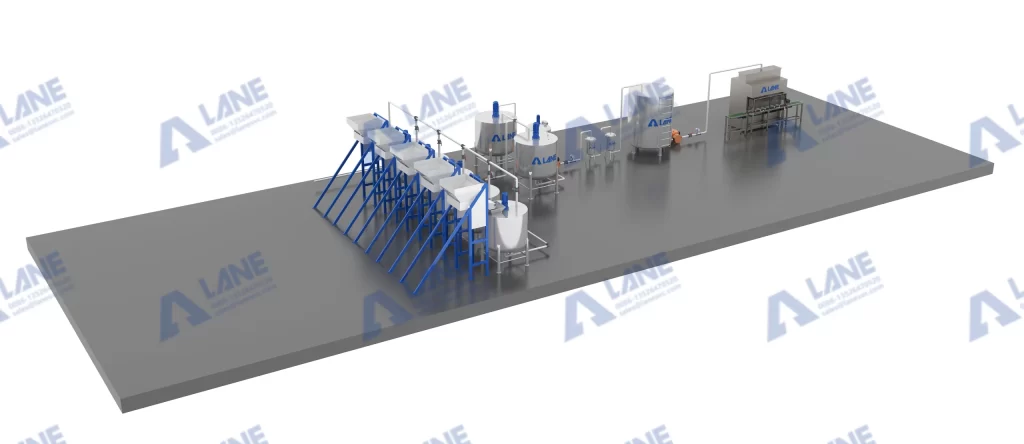
LANE Heavy Industry’s micronutrient liquid fertilizer production system incorporates multi-tank dissolving systems that prevent incompatible ingredients from meeting until the appropriate dilution stage. Our dissolving tanks with agitators allow controlled sequential addition of raw materials. This ensures that calcium-based compounds never concentrate with phosphates or sulfates.
Our equipment’s precise metering capabilities help you maintain the optimal dilution ratios that prevent precipitation. Additionally, LANE tank features pH monitoring ports that allow operators to acidify stock solutions when necessary.
The Problem
Many micronutrient liquid fertilizer formulations contain insoluble nutrients that must remain suspended throughout the product’s shelf life. Without proper suspension, these particles settle into hard-packed layers that cannot be redispersed.
The Solution
The key to preventing stratification lies in:
LANE addresses stability through advanced mixing technology. Our high-shear mixers and homogenizers properly incorporate suspending agents like polysaccharides, bentonite clays, or synthetic polymers. LANE’s specialized suspension tanks maintain continuous gentle agitation during holding periods, preventing settling before packaging.
The Problem
Chelation keeps metal micronutrients like iron, zinc, and manganese soluble and available to plants. However, achieving complete chelation during production requires precise control over temperature, mixing energy, and ingredient sequencing. Incomplete chelation leads to nutrient precipitation and reduced fertilizer effectiveness.
The Solution
LANE Heavy Industry’s liquid fertilizer production lines feature dedicated chelation reactors with advanced control systems. These stainless-steel vessels maintain optimal temperatures and provide the mixing intensity required for complete chelation reactions. LANE’s equipment ensures that metal ions are fully complexed with chelating agents like EDTA, DTPA, or organic acids before proceeding to final formulation.
The result is a micronutrient liquid fertilizer with all its nutrients fully available to plants and extended shelf life.
The Problem
pH affects the stability and effectiveness of micronutrient liquid fertilizer. Improper pH can cause chelation failure, precipitation, and degradation of raw materials. During production, maintaining consistent pH across batches requires careful monitoring and adjustment capability.
The Solution
All the reactors and mixers from LANE have inline pH monitoring with automated adjustment systems attached to them by design. Operators can monitor the pH levels as they add ingredients. Operators can adjust the pH in real time or let the system deal with it automatically. Our automation system eliminates the guesswork and inconsistency of manual pH adjustment.
The Problem
Suspension-type micronutrient liquid fertilizer products rely on uniform particle size for stability and efficacy. Particle size directly impacts both physical stability and biological availability of this type of liquid fertilizer. Particles that are too large settle quickly and particles that are too small may dissolve too rapidly or create handling difficulties. Achieving this narrow distribution consistently across production batches challenges even experienced manufacturers.
The Solution
LANE incorporates wet milling and high-shear dispersion equipment specifically designed for particle size reduction. Our crushers and homogenizers can achieve the tight particle size distributions required for premium suspension fertilizers.
In-process particle size monitoring using instruments like Coulter counters allows manufacturers to verify size distribution before proceeding to final formulation steps.
Our production lines can incorporate milling equipment calibrated specifically for micronutrient processing with retention times and energy inputs optimized for different mineral sources.
The Problem
The mixing and agitation system sometimes introduces air into the formulation and causes foaming. It can cause inaccurate filling volumes, oxidation of sensitive ingredients, and unsightly product appearance. Excessive foam also reduces the effective tank capacity and slows production throughput.
The Solution
LANE addresses foaming through multiple strategies. Our tank designs incorporate anti-vortex baffles and submerged inlets that minimize air entrainment during mixing. For high-shear operations where foaming is inevitable, we offer vacuum deaeration systems that remove entrained air before packaging.
The result is a micronutrient liquid fertilizer product with professional appearance and accurate nutrient concentrations.
The Problem
The most frustrating challenge for micronutrient liquid fertilizer manufacturers is batch-to-batch inconsistency. Variations in raw materials, operator technique, or equipment performance can produce final products that differ in color, viscosity, nutrient content, or stability. This inconsistency can make your business lose customer trust and complicate the quality assurance of your liquid fertilizer.
The Solution
LANE Heavy Industry provides micronutrient liquid fertilizer production lines with full automation capabilities. This includes PLC/DCS systems that manage every production phase. From raw material batching through mixing, chelation, and filling, automated controls ensure that each batch follows the same parameters.
LANE system features a centralized PLC control system, which allows efficient and easy management of the production process. This reduces labor costs and increases production tolerance. This gives operators precise control over ingredient additions, mixing times, and processing temperatures.
Comprehensive Solutions
LANE Heavy Industry Machine Technology Co., Ltd. brings over 20 years of experience to your micronutrient liquid fertilizer production line design. As “a machine supplier for Africa’s national fertilizer project with an annual output of 100,000 tons,” we understand the demands of large-scale manufacturing. Our equipment portfolio includes everything from dissolving tanks and chelation reactors to filling lines and packaging systems.
Customization Capabilities
Every production formulation has different requirements. LANE offers customized solutions tailored to your specific raw materials, production capacity, and product specifications. Our engineering team will work with you to design a production line that will address all your formulation challenges.
Technical Support and Training
We provide technical and after-sales support. Our engineers will instruct the site workers on how to install the machines and build the workshop. We will train your workers on how to operate the production line. We will ensure that your team can maximize the potential of your micronutrient liquid fertilizer production line.
Quality Assurance
With ISO and CE certifications, LANE equipment meets international quality standards. We provide 5 years of warranty. This reflects the confidence in our machinery’s durability and performance.
Q: What equipment is essential for micronutrient liquid fertilizer production?
A: A complete micronutrient liquid fertilizer production line typically includes dissolving tanks with agitators, chelation reactors, high-shear mixers, filtration systems, storage tanks, and automated filling equipment. LANE Heavy Industry provides integrated systems covering all these functions.
Q: How can I prevent precipitation in my formulations?
A: Precipitation prevention requires proper ingredient sequencing, pH control, and often the use of chelating agents. LANE’s multi-tank systems allow you to keep incompatible ingredients separate until proper dilution, while our automated pH controls maintain optimal conditions throughout production.
Q: What is the ideal particle size for suspension fertilizers?
A: For optimal stability and plant uptake, research suggests particle sizes in the range of 2 to 8 µm are particularly effective. LANE’s wet milling and high-shear dispersion equipment can achieve these specifications consistently.
Q: Can LANE customize equipment for my specific formulations?
A: Yes. LANE offers customized solutions based on your raw materials, production capacity, and product specifications. Contact us with your requirements, and our engineers will design an appropriate system.
Q: How long does it take to install and commission a production line?
A: For a complete micronutrient liquid fertilizer production line, LANE’s typical production time is no more than 30 days, with on-site installation and training provided by our engineers.
For more details, please feel free to contact us.
Henan Lane Heavy Industry Machinery Technology Co., Ltd.
Email: sales@lanesvc.com
Contact number: +86 13526470520
Whatsapp: +86 13526470520
Leave a Comment
LANE has more than 500 successful cases and is committed to providing customers with first-class solutions, high-end machinery and equipment, and one-stop pre-sales, sales and after-sales comprehensive customer service.