
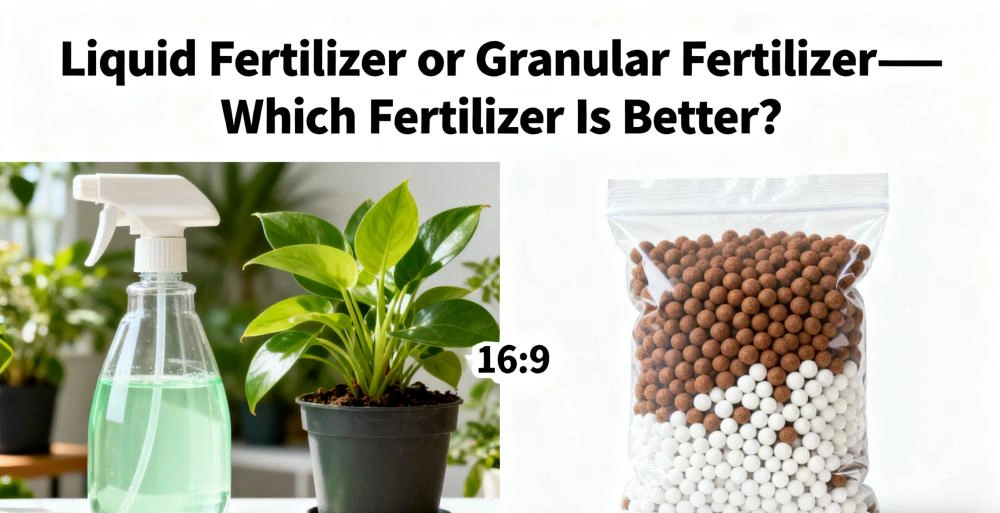
Liquid Fertilizer or Granular Fertilizer—— Which Fertilizer Is Better?
Fertilizer is one of the most essential component of modern agriculture. From small farmers to the large farming industry everyone uses fertilizers. It is also used in horticulture, and landscape management. When choosing fertilizer one question always comes up and becomes the topic of debate among farmers, agronomists, and gardeners, is liquid fertilizer or granular fertilizer better? The answer is not a very simple YES or NO.
Each fertilizer type has its own strengths, weaknesses, and ideal application scenarios. The uses of fertilizer are selected by factors as crop species, soil condition, climate, budget, and expected yield outcomes.
This article provides a detailed comparison of liquid and granular fertilizers. It also explores suitable raw materials, production approaches, and pros and cons, helping you make a fully informed decision for your fertilizer production business.
Liquid fertilizers has enhanced nutrient absorption and it is compatible with modern irrigation systems, making it highly useful. They can be applied through spraying, fertigation, drip irrigation, or direct soil injection. They deliver fast and immediate nutrient to the fertilizers. Because of its fast and reliable delivery it became popular among vegetable farming, greenhouse production, hydroponics, turf management, and large-scale plantation systems.
Suitable Raw Materials for Liquid Fertilizer
Liquid fertilizers can be manufactured from organic and inorganic materials. Some of the most common raw materials include:
Organic Raw Materials: Biogas slurry, livestock and poultry wastewater, fish protein hydrolysate, amino acids from plant or animal hydrolysis, seaweed extract, humic acid and fulvic acid solutions, Composted plant extract liquids, Molasses and fermented microbial nutrients.
Inorganic Raw Materials:Urea, ammonium nitrate, ammonium phosphate, Potassium chloride or potassium nitrate, micronutrient chelates (Fe, Zn, Mn, Cu, B, Mo)
Those material can be easily dissolved. It allows manufacturers to create a stable, homogenous liquid fertilizers.
Advantages
Rapid Nutrient : Liquid fertilizers delivers nutrient to the plant as a readily absorbable form. Plant can rapidly absorb the nutrient from the liquid fertilizers to dissolute. This makes liquid fertilizers ideal for correcting nutrient deficiency quickly, supporting fast-growing crops, enhancing nutrient uptake during critical growth stages.
Easy Integration with Irrigation: Liquid fertilizers can be applied through drip irrigation, center-pivot systems, fertigation lines and foliar spray systems. This makes this fertilizer more versatile and cost effective.
Uniform Distribution: Liquid fertilizer can be distributed equally throughout the farm. They provide excellent nutrient uniformity as they are already dissolved. Every droplet contains the same nutrient concentration, ensuring consistent application across fields.
Ideal for Precision Agriculture: With modern smart technology and machines farmers can adjust their fertilizer discharge at pinpoint location. This helps reduce waste, maximize yield, and protect soil health.
Useful for Controlled Environments Greenhouses, nurseries, and hydroponic systems rely heavily on liquid fertilizers because it can be used in controlled environment with spraying systems.
Disadvantages
Higher Production and Transport Cost: Liquid fertilizer containes large amount of water which increases packing cost, storage requirements, transportation cost. The nutrient ratio is lower then granuler fertilizers.
Shorter Shelf Life: Liquid fertilizers has shorter shelf life. It can settle, ferment, crystallize, separate over time, especially if not stabilized properly. This requires careful formulation and additives. LANE heavy industry produces mixing tank that can stabilize and mix additive safely and precisely.
More Sensitive to Handling Conditions: Liquid fertilizer has to be stored properly. Temperature and microbial activity may affect consistency. Stainless steel storage tanks and pumps must be properly maintained.
Higher Risk of Overuse: Because liquid fertilizer provide nutrient rapidly it can cause nutrient burn if not properly measured.
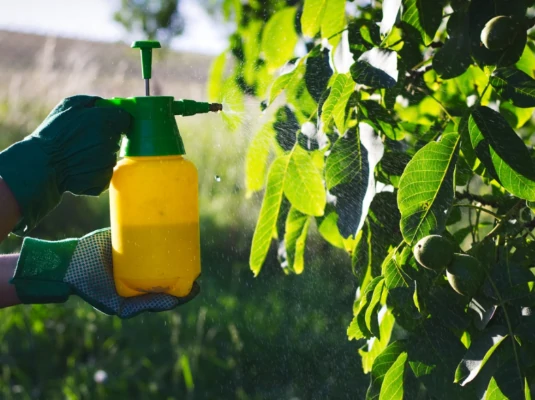
Granuler fertilizers are slow release fertilizer that comes in a form of pellet, prill or granule. They are commonly used in broad-acre farming, orchards, plantations, and long-term farm systems.
Suitable Raw Materials for Granular Fertilizer
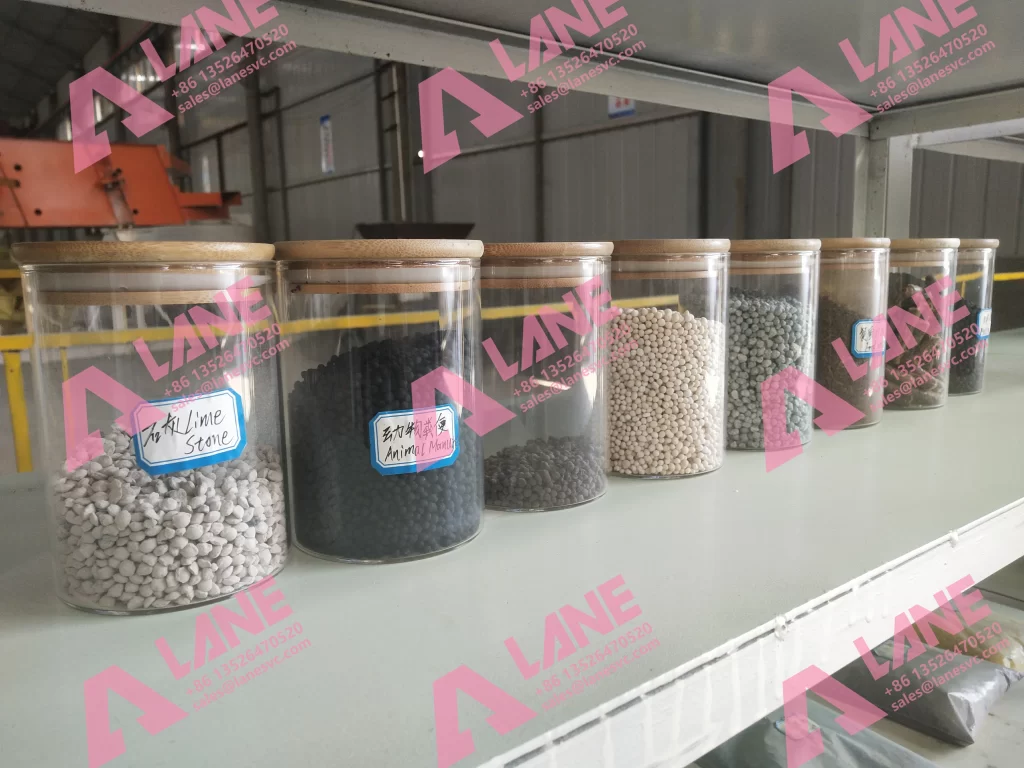
Organic Raw Materials: The suitable organic raw materials for the granular fertilizers are composted livestock manure, chicken manure, crop residues, sugarcane bagasse, food waste, peat soil, vermicompost, humic acid minerals, biochar.
Inorganic Raw Materials: The suitable inorganic or chemical raw materials are: Urea, Ammonium sulfate, DAP (diammonium phosphate), MAP (monoammonium phosphate), MOP (muriate of potash), SOP (sulfate of potash), Micronutrient powders,
Those materials can be processed with rotary drum granulation, Disk granulation, Double roller granulation, Stirring pin granulation. LANE heavy machinery manufactures those granulation with their cutting edge technology.
Advantages
Slow and Controlled Nutrient Release: Granular fertilizer breaks down slowly and gradually. it feeds plants over weeks or months. This controlled release is benificial for trees, long-cycle crops (corn, sugarcane, oil palm), landscaping and turf.
Cost-Effective: Granule fertilizers are cheaper to produce, store and transport because they are compact, do not contain water, have a long shelf life.
Easier Storage and Handling: Granular fertilizers are stable, dry, and resistant to temperature fluctuations. They require no special storage tanks or pumping systems.
Bulk Application: Granules fertilizers can be distributed through the mechanical spreaders. It can be discharge fast that makes them ideal for plantation agriculture and commercial fields.
Suitable for Blending: Granules can be blended into custom NPK ratios. It allows manufacturers to create custom formulas.
Disadvantages
Slower Nutrient Availability: It needs time to dissolve and has has slow interact with soil moisture. This delay can be problem for nutrient-deficient crops, early growth stages, crops with fast nutrient uptake needs.
Risk of Uneven Distribution: Low quality granules very in size, it causes inconsistency in nutrient delivery.
Lower Efficiency in Dry Conditions: Granules require water to dissolve. In hot weather or sandy soils they wont dissolve easily. It reduces effectiveness.
Not Suitable for Precision: Granules cannot be used with drip irrigation or hydroponics, limiting their use in modern, high-tech agriculture systems.
| Category | Liquid Fertilizer | Granular Fertilizer |
| Nutrient Release | Immediate | Slow, extended |
| Cost per Nutrient Unit | Higher | Lower |
| Shelf Stability | Moderate, sensitive | Very stable |
| Best For | Fast crops, greenhouses, fertigation | Plantations, orchards, long-term crops |
| Ease of Application | Compatible with irrigation | Simple for large fields |
| Risk of Burn | Higher if overdosed | Lower |
| Environmental Impact | Better efficiency but risk of runoff | May cause leaching if misapplied |
| Precision Agriculture | Excellent | Limited |
| Suitability for Organic Systems | Very suitable | Very suitable |
Both fertilizer has their own advantages and disadvantages . None of them is universally better. Choose the fertilizer production line depending on the local, regional demand and choice of fertilizer depends on the season and crop.
Why Choose Liquid Fertilizer: If you need fast results, work with hydroponics or greenhouse systems, want precision fertigation, are addressing nutrient deficiencies, grow vegetables or short-cycle crops, require uniform, immediate nutrient uptake.
Why Choose Granular Fertilizer: If you grow long-cycle crops (sugarcane, corn, oil palm, fruit trees), need slow and steady nutrient supply, want cost-effective bulk fertilization, require long shelf life and low storage cost, apply fertilizer before planting or during land preparation.
Both liquid and granular fertilizers impact the environment differently. They bosth has different application. Most of time environmental affect actually depends on the raw materials.
Liquid Fertilizers
Granular Fertilizers
Modern sustainable agriculture now uses a combination of both to improve soil fertility. It not only maximizes crop performance some time the choices leads to batter soil health.
The best fertilization strategy is Hybrid approach. In this approach farmers use granular fertilizer for foundational soil nutrition and liquid fertilizer for supplemental feeding.
This dual strategy ensures:
The answer to the question is liquid or granular fertilizer better? Is not simple Liquid fertilizers and granular fertilizer both has tremendous agricultural value as they serve different purposes.
Liquid fertilizers deliver immediate nutrition and support precision agriculture systems, making them ideal for vegetables, greenhouse crops, and hydroponics while granular fertilizers deliver long term soil nourishment, making them superior for plantations, orchards, and large scale agricultural operations.
Sometimes the cost became the most crucial factor while choosing the fertilizers. Ultimately, the best fertilizer is not liquid or granular, it is the one that matches your crop, your soil, your system, and your goals.
The optimal fertilizer strategy for any specific operation depends on careful consideration of multiple factors, including crop type, soil conditions, available equipment, labor resources, and economic constraints. As agricultural technology continues to evolve, both liquid and granular formulations are likely to see significant impovements in their formulations. LANE heavy industry has the soulutuion for all.
For more details, please feel free to contact us.
Henan Lane Heavy Industry Machinery Technology Co., Ltd.
Email: sales@lanesvc.com
Contact number: +86 13526470520
Whatsapp: +86 13526470520
Leave a Comment
Latest Posts
LANE has more than 500 successful cases and is committed to providing customers with first-class solutions, high-end machinery and equipment, and one-stop pre-sales, sales and after-sales comprehensive customer service.